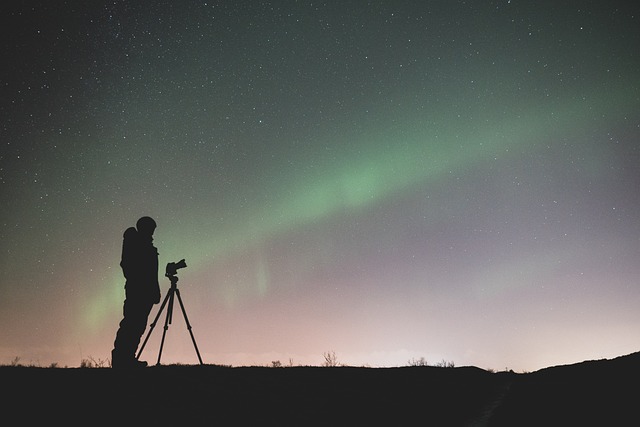
If you’re shooting the Milky Way, the Northern Lights, or deep-sky objects, choosing the right tripod is essential. A good tripod doesn’t just hold your gear — it resists vibration, stays level in wind, and pairs well with a star tracker or mount.
This guide breaks down the top tripods across budgets, helps you compare key specs, and explains exactly what to look for when buying for astrophotography.
Note: This post contains affiliate links. If you buy through these links, I may earn a small commission at no extra cost to you. As an Amazon Associate, I earn from qualifying purchases.
Best Tripods for Astrophotography (Quick Verdict)
In a hurry? Here’s what to buy:
- Best for Beginners & Budget Setups: K&F Concept 79″ Tripod
An affordable, lightweight tripod that offers good stability for wide-field astrophotography and entry-level setups. - Best for Enthusiasts & Travel Astrophotography: 3 Legged Thing Punks Brian 2.0
A strong, carbon-fibre tripod with excellent versatility. Ideal for long exposures, travel, and pairing with star trackers. - Best for Heavy Gear & Maximum Stability: Gitzo Systematic Series 5
A professional-grade tripod built for heavy cameras, long lenses, and serious astrophotography where vibration control matters most
Quick Comparison: Top Tripods for Astrophotography
| Tripod | Best For | Max Height | Payload Capacity | Material |
|---|---|---|---|---|
| K&F Concept 79″ Tripod | Budget astrophotography | ~79″ | ~22 lbs | Aluminium/Alloy |
| 3 Legged Thing Punks Brian 2.0 | Great all-around choice | ~73″ | ~14 kg | Carbon fibre |
| Gitzo Systematic Series 5 | Heavy gear & professionals | ~134 cm | ~40 kg | Carbon fibre |
How to Choose the Right Tripod for Astrophotography
Astrophotography has unique needs — long exposures, dark skies, and often remote shooting locations. Here’s what matters most:
Key Features to Look For
Stability Over Height
A tripod that resists vibration — especially during long exposures — is worth more than one that simply extends tall.
Load Capacity
Make sure the tripod can comfortably support your camera + lens + any trackers or mounts you use. A 20 lb+ capacity is a solid target for most astrophotography setups.
Material: Carbon Fibre vs Aluminium
- Carbon fibre → lighter and better at damping vibration.
- Aluminium → more budget-friendly but heavier.
Leg Locks & Weather Resistance
Twist locks and sealed mechanisms help when working in cold or moist night conditions.
Quick-Release & Compatibility
Think about how easily you can swap camera gear and whether the tripod pairs well with heads and star trackers.
Best Tripods for Astrophotography
Best Budget Choice — K&F Concept 79″ Tripod
The K&F Concept Aluminium Tripod is a popular choice among photographers for its affordability and functionality.
Why it’s great: A solid entry-level tripod that still packs enough stability for long-exposure sky shots. Easy to carry and versatile for travel adventures.
Pros
✔ Excellent value for money
✔ Lightweight and portable
✔ Converts to a monopod for flexibility
Cons
✖ Aluminium build is heavier than carbon
✖ May flex slightly with very heavy gear
Best for: Beginners and hobbyists on a budget.

Best All-Around Pick — 3 Legged Thing Punks Brian 2.0
The 3 Legged Thing-Punks Brian 2.0 Tripod (what a name!) is a highly versatile, competitively priced mid-range option that’s well-regarded among photographers.
Why it’s great: A well-rounded choice that blends stability, versatility, and portability. Its clever detachable leg design means you can convert it to a monopod or tabletop support.
Pros
✔ Great payload for most astrophotography gear
✔ Carbon fibre keeps weight down
✔ Includes quality ball head and carry bag
Cons
✖ Slightly pricier than basic tripods
✖ Some competitors offer marginally better vibration resistance
Best for: Enthusiasts who want a tripod that travels well and performs great.

Best for Heavy Gear & Pros — Gitzo Systematic Series 5
Many consider the Gitzo series 5 tripod to be one of the best on the market due to it’s its exceptional build quality, stability, and weight capacity.
Why it’s great: If you’re shooting heavy rigs or want rock-solid stability, this is hard to beat. Its modular design lets you add accessories and adapt over time.
Pros
✔ Exceptional stability and build quality
✔ Huge payload capacity
✔ Modular and expandable
Cons
✖ Very high price point
✖ Heavier to carry for travel
Best for: Professionals and serious astrophotographers.

New to night sky photography? Start strong with our guide to 6 of the best astrophotography cameras for beginners — perfect picks for capturing stars without the stress.
Tripod Head Types
Choosing the right tripod head is just as important as choosing the tripod itself. A poor head can introduce vibration, make precise framing difficult, and limit what your setup can handle — especially during long exposures.
If you’re new to night sky photography, this pairs well with our astrophotography for beginners guide to understand how your full setup works together.
Ball Heads (Best for Most Astrophotographers)
Ball heads are the most popular choice for astrophotography thanks to their speed and flexibility, especially for wide-field shooting. They’re commonly used alongside DSLR and mirrorless cameras.
Why they work well for astro:
- Quick to adjust when framing the Milky Way
- Compact and easy to transport
- Ideal for wide-angle lenses and travel setups
What to look for:
- A high load rating (well above your camera + lens weight)
- Smooth movement without “creep” once locked
- A solid quick-release plate
Best for:
Wide-field astrophotography, landscape astro, travel rigs, and beginner to intermediate setups.
Geared Heads (Best for Precision Framing)
Geared heads allow extremely fine adjustments on each axis, making them ideal for precise compositions — particularly when accuracy matters more than speed.
Why you’d choose one:
- Pinpoint accuracy when aligning stars or foregrounds
- No sudden movement when locking the head
- Excellent for repeatable framing
Trade-offs:
- Heavier and slower to use
- More expensive than ball heads
Best for:
Deep-sky astrophotography, tracked setups, and photographers who prioritise precision over speed.
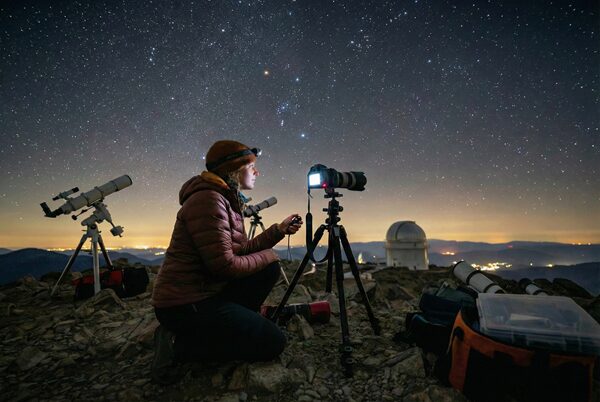
What Should You Choose?
- Most astrophotographers: A high-quality ball head
- Precision-focused or tracked setups: A geared head
- Heavy lenses or star trackers: Prioritise load capacity over size
Common Tripod Mistakes in Astrophotography
Even with good equipment, small mistakes can ruin sharp night-sky images. These issues come up frequently when photographers are just getting started.
Extending the Centre Column
Raising the centre column reduces stability and increases vibration — a major problem during long exposures.
Fix:
Keep the centre column as low as possible and extend the legs instead. This is especially important when shooting with the camera setups recommended in our best Astrophotography Cameras For Beginners guide.
Underestimating Wind and Vibration
A tripod that feels stable during the day can struggle at night when wind picks up.
Fix:
Use a tripod weight hook, lower your shooting height, and shield the setup where possible.
Overloading the Tripod
Mounting gear near or beyond the tripod’s rated capacity leads to flex and image blur.
Fix:
Choose a tripod rated well above your total camera, lens, and accessory weight.
Using a Cheap Tripod Head
Even solid tripod legs can be undermined by a low-quality head that slips or drifts.
Fix:
Match your tripod head’s load rating to your gear, especially when mounting heavier lenses or accessories.
Not Levelling the Tripod
An uneven base makes framing more difficult and can affect star tracker alignment.
Fix:
Use built-in bubble levels or a levelling base before mounting your camera or tracker.
Setting Up on Unstable Ground
Soft ground, wooden decking, or loose gravel can introduce subtle movement.
Fix:
Stamp down tripod feet, use spiked feet if available, and avoid unstable surfaces.
Final Thoughts
Choosing the right tripod makes a huge difference in your astrophotography results. Stable gear keeps stars sharp, reduces motion blur, and helps you get more useable frames per night.
Whether you’re just getting started or upgrading your rig, there’s a tripod here for you — from budget-friendly to pro-grade.
Frequently Asked Questions
Yes — night sky photography involves long exposures, so you want something that limits vibration and holds your setup completely steady.
For astrophotography, carbon fibre is often worth it because it’s lighter and better at damping vibration.
You can, but the best astrophotography tripods have better load capacity and vibration resistance.
Heavier tripods are generally more stable, which is ideal for long-exposure astrophotography. A good rule is to choose a tripod that can support at least double the weight of your camera, lens, and any accessories.
Not necessarily. While centre columns add height, they can also reduce stability when extended.