If you’re new to astronomy and want something simple, affordable, and easy to use, a tabletop telescope can be a perfect first step. These compact scopes are ideal for adults who want to explore the night sky without hauling around a bulky tripod or dealing with complicated setup.
If you’re just starting out with telescopes, our How To Buy A Telescope guide will help you understand what to look for before choosing your first scope.
Tabletop telescopes won’t show deep-space images like the Hubble, but they do offer a satisfying way to start — you’ll easily see the Moon, planets, star clusters, and under good skies, some brighter nebulae and galaxies.
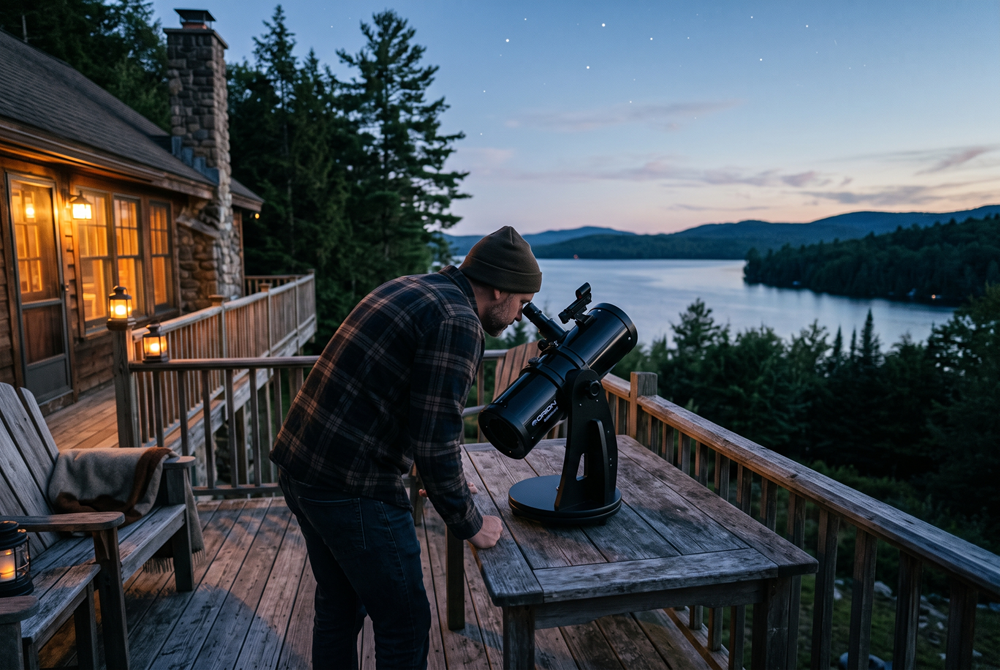
In this guide, you’ll learn what to expect from a tabletop telescope, how to choose wisely, and which models offer the best value for beginners.
You can also explore the basics of observing the night sky with the Astronomy for Beginners guide, which covers everything you need to get started.
Disclosure: This post contains affiliate links. If you buy through these links, I may earn a small commission at no extra cost to you. As an Amazon Associate, I earn from qualifying purchases.
Quick Verdict (If you’re short of time)
- Skywatcher Heritage 90 – Compact, sharp lunar/planetary views; very low maintenance.
- Celestron Starsense 114 – Largest aperture here; smartphone navigation makes finding objects easy.
- Celestron NexStar 4SE – GoTo tracking + excellent planetary detail; perfect for automation
Tip: Start with low power to locate objects, then switch to higher magnification for detail
Choosing a Tabletop Telescope (Beginner’s Guide)
Before jumping into specific models, here’s what really matters when choosing your first telescope.
1. Aperture (The Most Important Factor)
Aperture is the diameter of the telescope’s main lens or mirror. More aperture means more light, which results in brighter, clearer views.
- 70–90mm: Excellent for the Moon, planets, and bright clusters
- 100–130mm: Ideal beginner range for deeper-sky objects
- Above 130mm: Usually too large for tabletop designs
2. Focal Length & Field of View
- Short focal length (300–600mm): Wide views; great for star clusters
- Long focal length (900–1300mm): Higher magnification; better for planets
Understanding how eyepieces affect magnification will help you get the best performance from your telescope — see our Telescope Eyepiece Magnification Explained guide for a full breakdown.
3. Mount Type
Most tabletop telescopes use:
- Dobsonian-style mounts — simple, stable, beginner-friendly
- Alt-azimuth mounts — intuitive up/down/left/right movement
- GoTo mounts — motorised tracking and automated object finding
4. Ease of Use & Maintenance
- Reflector types may need occasional collimation
- Maksutov-Cassegrain types are very low-maintenance
- Tabletop scopes require a solid surface (table, wall, camping table)
5. Accessories
Look for models that include:
- At least two eyepieces
- A red-dot or optical finder
- Smartphone adapter compatibility (optional)
Best Tabletop Telescopes for Adults
Skywatcher Heritage-90 Cassegrain Telescope
This compact Maksutov-Cassegrain punches above its weight. The long focal length delivers excellent magnification for the Moon, Jupiter, Saturn, Mars, and double stars.
It requires virtually no collimation and is ideal for beginners who want simplicity.
Pairing your telescope with the right accessories can make a big difference — check out our guide to the Best Telescope Eyepieces For Stargazing.
No products found.
Best for: beginners wanting sharp, high-contrast lunar and planetary views
What you’ll see:
- Moon: razor-sharp craters and mountain detail
- Planets: Jupiter’s moons, Saturn’s rings, Mars’ polar cap
- Deep sky: Orion Nebula and bright clusters
Key Specs:
| Model Name/Number : | Skywatcher Heritage-90 Cassegrain Telescope |
| Telescope Type : | Maksutov/Cassegrain |
| Type Of Mount : | Altazimuth |
| Aperture : | 3.54″ (90mm) |
| Focal Length : | 1250mm (f/13.9) |
| Eyepieces Included : | 25mm and 10mm |
| Eyepiece Magnification : | 50x (25mm) and 125x (10mm) |
| Weight : | 5.1 kg |
| Rating : | 9.7/10 |
Celestron StarSense Explorer 114mm
This model uses Celestron’s StarSense app, which scans the sky and guides you to objects using your smartphone — no star-hopping required.
The 114mm aperture provides excellent light-gathering power, while the fast focal ratio offers wide, bright views.
For higher magnification without buying additional eyepieces, you can also use one of the options in our guide to the Best Barlow Lens For Your Telescope.


Best for: total beginners who want help finding objects
What you’ll see:
- Moon & planets with good detail
- Orion Nebula, Pleiades, bright galaxies
- Ideal for urban and suburban observers
Key Specs:
| Model Name/Number : | Celestron 22480 Starsense Explorer |
| Telescope Type : | Reflector |
| Type Of Mount : | Dobsonian Style |
| Aperture : | 4.48″ (114mm) |
| Focal Length: | 450mm (f/3.9) |
| Eyepieces Included : | 17mm and 10mm |
| Eyepiece Magnification : | 26x (17mm) and 45x (10mm) |
| Weight : | 1.9 kg |
| Rating : | 9.8/10 |
Celestron NexStar 4SE GoTo Telescope
This is the most advanced option in the list. The motorised GoTo mount automatically finds and tracks thousands of objects, making it ideal for beginners who want advanced features without complexity.
The optics are excellent, particularly for the Moon and planets.

Best for: adults who want automated tracking and premium planetary views
What you’ll see:
- Extremely crisp lunar detail
- Vivid Saturn rings and Jupiter bands
- Bright nebulae and clusters
Key Specs:
| Model Name/Number : | Celestron 11049 NexStar 4SE Telescope |
| Telescope Type : | Catadioptric |
| Type Of Mount : | GoTo |
| Aperture : | 4.00″ (100mm) |
| Focal Length: | 1325mm (f/13) |
| Eyepieces Included : | 25mm |
| Eyepiece Magnification : | 53x (with higher possible, using different eyepieces) |
| Weight : | 9.5 kg |
| Rating : | 9.8/10 |
Comparison Table
| Model | Aperture | Focal Length | Type | Best For | Ease of Use | Tech |
|---|---|---|---|---|---|---|
| Skywatcher Heritage-90 | 90mm | 1250mm | Mak-Cass | Moon & planets | Very easy | None |
| StarSense Explorer 114 | 114mm | 450mm | Reflector | Guided observing | Very easy | Smartphone mapping |
| NexStar 4SE | 100mm | 1325mm | Catadioptric | Automated tracking | Moderate | Full GoTo |
Tips for Getting the Best Views
- Let the telescope cool for 10–20 minutes
- Start with low magnification, then increase
- Avoid viewing over rooftops or heat sources
- Observe from the darkest location possible
If you’re unsure what objects to start with, our Beginner Stargazing Guide explains how to find and observe planets, nebulae, and star clusters.
Tabletop v Full-Size Telescopes
| TableTop | Full-Size |
|---|---|
| Portable | More light gathering |
| Budget-friendly | Better long term growth |
| Easy to store | Larger and heavier |
| Great for beginners | More set-up |
If you’re considering larger setups, you can compare options in our guides to the Best Reflector Telescopes for Beginners ..and Best Refractor Telescopes for Beginners.
Conclusion
A tabletop is one of the best and easiest ways for adults to start exploring the night sky without complexity or major expense.
To get the most from your setup, you may also want to explore our Telescope Accessories Guide for essential upgrades like eyepieces and filters.
All three models above deliver excellent performance, but each suits slightly different needs:
- Heritage-90 – Compact, Sharp, Low Maintenance.
- Starsense 114 – beginner friendly navigation & wide views.
- NexStar 4SE – Premium automated observing.
Whatever you choose, you’ll get stunning views of the Moon, Planets and many bright deep-sky objects – and a perfect first step into astronomy.
F.A.Q – Tabletop Telescopes For Beginners
Yes - tabletop telescopes are excellent for adults, especially beginners. They offer great optical performance in a compact. stable design.
For convenience and ease of use, yes. Tabletop telescopes are ideal for quick sessions, portability, camping and small spaces. Full-size scopes offer more aperture and long time growth for serious astronomy.
No - tabletop telescopes are designed to sit on a sturdy surface (table, patio wall, garden bench). This makes them lighter and more portable. Many models can be mounted on a tripod if you buy an adapter.
A good tabletop telescope can show: The Moon in crisp detail, Saturn's rings, Jupiter's cloud bands and moons, Mars' polar ice caps, Bright Deep-sky objects like the Orion Nebula, Andromeda Galaxy and star clusters. They won't show faint galaxies like professional scopes, but they're excellent for casual astronomy.
Yes, if you want the telescope to automatically find and track objects. GoTo models (e.g., Celestron 4SE) save time and remove the frustration of star-hopping - perfect for adults who want accuracy and convenience.