If you’ve ever struggled to point your telescope at Jupiter, lost Saturn after a slight bump, or spent more time aiming than observing, a better finderscope can completely transform your stargazing experience.
Most beginner telescopes include small, frustrating finder scopes that make locating objects harder than they should be. Upgrading to the right finder can make alignment faster, improve accuracy, and make observing far more enjoyable.
In this guide, we’ll look at the best finderscopes for telescopes, explain the different types available, and help you choose the right one for your observing style.
Finderscope Comparison
| Finder Scope | Type | Best For | Main Advantage |
|---|---|---|---|
| Omegon Red Dot | Red Dot | Beginners | Simple aiming |
| StarPointer | Red Dot | Easy setup | Lightweight |
| Astromania | RACI Optical | Deep sky | Comfortable viewing |
| StarPointer Pro | Reflex | Versatile observing | Wide viewing window |
| Telrad | Reflex/Telrad | Star hopping | Excellent sky navigation |
Why Use a Finder Scope?
Simple—it saves time and hassle. Instead of squinting and fiddling to get the moon or that elusive planet in your view, a quality finder makes the whole process smooth and enjoyable.
Many beginners first learn how to navigate the night sky with binoculars before moving on to telescopes and finder scopes, as covered in our Complete Guide to Binocular Accessories for Stargazing.
You could say that a finder scope is like a mini version of your telescope. It gives you a wider field of view and helps line up your main telescope with ease. Just imagine trying to find a pinpoint star in the vast sky with only your telescope; it’s tricky without help. That’s where this tool shines.
Types of Finder Scopes
There are mainly two types of finder scopes: optical and non-optical.
The optical ones look just like a mini telescope and are great for spotting faint objects. These are basically small telescopes with low magnification (usually between 6x and 9x) and crosshairs to aid in targeting.
RACI (Right Angle Correct Image) finders are especially popular with Dobsonian telescope users because they provide a comfortable viewing angle and a correctly oriented image.
Finder scopes become especially important on Newtonian and Dobsonian telescopes, which is why many beginners read our The Best Reflector Telescopes For Beginners guide before upgrading their setup.
Then there are non-optical ones, like Red Dot Finders, Reflex Finders or Telrad Finders. These are perfect for lining things up quickly.
Red Dot Finders project a red dot or reticle onto a transparent screen. They are simple to use, lightweight, and inexpensive.
Reflex Finders are similar to red dot finders but with more complex reticle designs and sophisticated targeting.
Telrad Finders have a reflex sight that projects concentric circles onto a glass screen and are excellent for identifying and aligning larger areas of the sky.
Choosing the Right Finder Scope
Picking the right one largely depends on what you plan to gaze at. For the casual sky-watcher, a basic red dot might work wonders. But if you’re an intermediate or advanced user, perhaps diving into deep-sky objects, go for something with a bit more power and precision.
Before choosing a finder scope, it helps to understand how different telescope types affect your observing experience in our How To Buy A Telescope – A Beginner’s Guide article.
A well-crafted finder scope not only enhances your viewing experience but also adds durability. Solid construction means it can withstand the knocks and bumps of regular use without affecting performance.
A good reticle design is right up there in level of importance. Whether it’s a basic crosshair or something more intricate, having a clear reticle makes lining up the telescope so much easier. Also, some people swear by illuminated reticles for night use as it ensures you won’t lose sight of that crucial target in a dark sky.
Aperture and magnification are worth considering. A larger aperture gives you more light-gathering capability, which is crucial in spotting those faint celestial objects. The right amount of magnification helps to pinpoint details without going overboard and making objects hard to locate.
Many smaller refractor telescopes include basic finder scopes, but upgrading can make aiming far easier, as explained in The Best Refractor Telescopes For Beginners.
Compatibility is another key criterion. Your finder scope should seamlessly attach to your telescope, and manufacturers often offer compatibility charts or guides. A mismatch can result in frustrating installations or recalibrations.
Budgeting appropriately can guide your choices. Higher-end models often boast more advanced features like illuminated reticles or superior optics, but that doesn’t mean you can’t find great value in reasonably priced options.
Considering how often and where you’ll use your telescope might impact how much you’re willing to spend.
Note: This post contains affiliate links. If you buy through these links, I may earn a small commission at no extra cost to you. As an Amazon Associate, I earn from qualifying purchases.
5 Great Finderscopes For Your Telescope
Omegon Red-Dot Finderscope

The Omegon Red-Dot Finderscope is one of the easiest ways to improve the experience of using a beginner telescope. Instead of struggling to line up objects through a narrow telescope eyepiece, the red dot acts like a pointer against the night sky, making alignment much faster and more intuitive.
Unlike traditional optical finderscopes, there’s no magnification involved. You simply keep both eyes open and place the red dot over the object you want to observe. For beginners especially, this feels much more natural than using a small magnified finder with an upside-down image.
I particularly like red dot finders for casual observing sessions and quick planetary viewing because they remove a lot of the frustration that new telescope users often experience.
Best For:
Beginners who want a simple, lightweight finder for quickly aiming their telescope.
Key Features
- Lightweight LED red dot finder
- Clear projection lens
- Adjustable brightness control
- Compatible with many SkyWatcher, Celestron, Vixen and GP-style mounts
- Quick and simple installation
Pros
- Extremely beginner-friendly
- Fast target acquisition
- Lightweight and compact
- Affordable upgrade over many stock finders
- Comfortable to use
Cons
- No magnification for faint deep-sky objects
- Less effective under heavy light pollution
Overall, the Omegon Red-Dot Finderscope is an excellent entry-level option for astronomers who want a simple, frustration-free way to aim their telescope.
Celestron 51630 Starpointer Finderscope


The Celestron StarPointer is designed to make telescope alignment quick and straightforward. If you’ve ever struggled to find planets or bright stars through your telescope, this finder can make a huge difference to the overall observing experience.
One of the biggest advantages of the StarPointer is how natural it feels to use. The sky remains right-side up, matching what you see with your naked eye, which makes navigation much easier for beginners.
The adjustable red dot brightness is also useful. Keeping the dot dim helps preserve night vision during astronomy sessions, while increasing brightness makes daytime alignment easier.
Its lightweight design means it won’t add unnecessary bulk to your telescope setup, and installation is usually very simple thanks to its broad compatibility with many telescope models.
Best For:
Beginner astronomers looking for a reliable and easy-to-use red dot finder.
Key Features
- Red dot “point-and-look” functionality
- Right-side-up sky orientation
- Adjustable red dot brightness
- Compact and lightweight design
- Includes mounting base and battery
Pros
- Very easy to align
- Great for beginners
- Lightweight and portable
- Wide telescope compatibility
- Helps reduce aiming frustration
Cons
- No magnification
- Less useful for faint objects and advanced star hopping
For newcomers to astronomy, the StarPointer strikes a great balance between simplicity, reliability and affordability.
Astromania 9×50 Finder Scope

The Astromania 9×50 Finder Scope is a major upgrade over the small finder scopes included with many beginner telescopes. With its larger 50mm aperture and 9x magnification, it gathers significantly more light, helping you spot stars and objects that are often invisible to the naked eye.
For deep-sky observing especially, a 9×50 finder can make navigation far easier. The brighter image and wider star visibility are incredibly helpful when star hopping between targets.
One thing to particularly like about 9×50 finders is how much easier they make locating faint reference stars compared to basic red dot finders. Once you begin exploring galaxies, nebulae and star clusters, the extra light gathering becomes very useful.
The Astromania model features fully multi-coated achromatic optics for a brighter and clearer image, along with crosshairs for accurate centring. The alignment system is straightforward to adjust, and the finder fits many popular telescope mounts.
Many amateur astronomers also prefer 9×50 finders over smaller 6×30 models because they reveal more stars and make star hopping easier under darker skies.
Best For
Intermediate astronomers, star hopping and locating faint deep-sky objects more easily.
Key Features
- 9x magnification with 50mm aperture
- Crosshair reticle for accurate targeting
- Fully multi-coated achromatic optics
- Bright image for locating faint objects
- Adjustable alignment screws
- Compatible with many telescope finder brackets
Pros
- Excellent for star hopping
- Brighter view than smaller finder scopes
- Makes faint stars easier to locate
- Good upgrade from stock finder scopes
- Sharp and clear optics
Cons
- Larger and heavier than red dot finders
- Straight-through design can feel awkward near the zenith
- Requires proper alignment for best accuracy
For astronomers wanting a more capable optical finder, the Astromania 9×50 is a strong upgrade that greatly improves manual navigation and deep-sky observing.
Celestron 51635 StarPointer Pro Finderscope
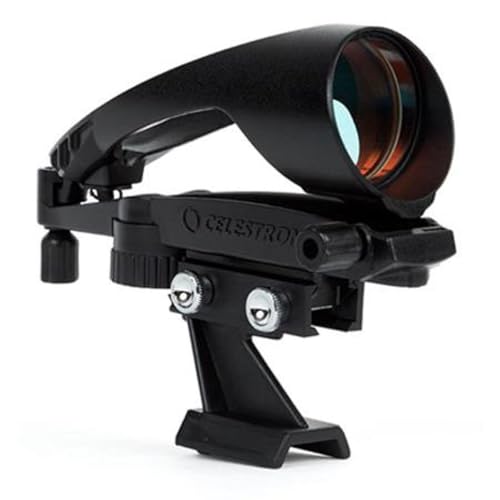
The Celestron StarPointer Pro improves on the traditional red dot finder design by using a dual-circle reflex reticle instead of a single dot. This makes it easier to centre targets accurately without obscuring them behind a bright red point.
The large viewing window is one of its standout features. Compared to smaller red dot finders, it offers a wider and more comfortable field of view, enabling you to locate celestial objects more quickly.
What’s also great is how intuitive the dual-circle reticle feels once you get used to it. It offers better precision for alignment and works particularly well when locating brighter deep-sky objects or navigating crowded star fields.
The tool-free dovetail mounting system makes installation fast and straightforward on most compatible telescopes.
Best For
Astronomers who want a more advanced reflex finder with a wider field of view.
Key Features
- Dual-circle reflex reticle
- Large 40mm viewing window
- Bright adjustable LED illumination
- Tool-free dovetail mounting
- Lightweight and portable
Pros
- Wide field of view
- More precise than standard red dot finders
- Easy to install and align
- Comfortable viewing experience
- Great balance between simplicity and functionality
Cons
- More expensive than basic red dot finders
- No magnification for faint targets
The StarPointer Pro is an excellent mid-range finder for astronomers who want a more refined and capable aiming system without moving to a full optical finder.
Explore Scientific Telrad Viewfinder
No products found.
The Telrad Viewfinder has become one of the most respected finder systems in amateur astronomy, particularly among Dobsonian telescope users and deep-sky observers.
Instead of magnifying the sky, the Telrad projects illuminated concentric circles onto a transparent screen. These circles correspond to known angular measurements in the sky, making it incredibly effective for star hopping and navigating between objects.
One reason experienced astronomers love the Telrad is that many printed star charts and astronomy apps include Telrad circle overlays, making object location far more intuitive.
Although it looks larger than a standard red dot finder, the wider viewing area and precision targeting make a huge difference during real observing sessions.
Best For
Star hopping, Dobsonian telescopes and serious visual observing.
Key Features
- Zero-magnification reflex design
- Illuminated concentric circle reticle
- 0.5°, 2° and 4° targeting rings
- Wide viewing window
- Quick-release mounting system
Pros
- Outstanding for star hopping
- Extremely accurate targeting
- Very intuitive once learned
- Popular with experienced observers
- Excellent for Dobsonian telescopes
Cons
- Larger and bulkier than standard finders
- Requires some learning for beginners
- Needs AA batteries
For deep-sky observing and manual telescope navigation, the Telrad remains one of the best and most trusted finder systems available.

Guide to Proper Installation and Calibration
Setting up your finder scope correctly can greatly enhance your stargazing sessions. Installation involves securely attaching your finder scope to the main telescope. Most finder scopes come with a dovetail bracket which makes mounting straightforward, but always double-check that it’s tight with no wobble to ensure accuracy.
Once mounted, calibration—or alignment—is crucial. Start this process during the daylight using a distant object like a church spire or a tree. Centre the object in your main telescope and then adjust the finder scope’s alignment screws until the same object is centred in the finder’s view.
Accurate telescope alignment becomes even more important if you plan to start imaging the night sky, which we explain in Astrophotography For Beginners – A Guide to Capturing The Night Sky.
Even slight misalignments can lead to frustrations later at night. After an initial daylight setup, fine-tuning under a clear night sky is recommended. Aligning with a bright star ensures everything’s perfectly in-sync.
Preserving your night vision is just as important as accurate alignment, which is why we recommend using one of the options featured in Best Astronomy Flashlights.
Regular maintenance of your finder scope is also essential to keep its performance top-notch. Clean the lenses carefully with a lint-free cloth to avoid scratches. Periodically check fixings to ensure nothing has come loose, especially if you regularly transport your equipment.
If things go off-track, a common troubleshooting step is to recheck alignment and retighten any loose screws. This simple action often resolves minor inaccuracies.
How to Maximize Your Experience with a Finder Scope
Take the time to familiarize yourself with the settings and adjustments. It makes finding objects so much easier and faster. You’ll start to notice the little tweaks that make a big difference.
Despite your best efforts, things won’t always go smoothly. Common issues, like losing focus or failing to spot smaller stars, happen to the best of us. Don’t let these hiccups discourage you. Instead, approach them as learning opportunities. Sometimes a bit of troubleshooting is all it takes to get back on track.
As you get comfortable, challenge yourself to enhance your observational techniques. Start with visible objects before slowly moving onto fainter, more elusive stars and planets. It’s a bit of trial and error, but with patience, your skills will grow, and so will your appreciation for the universe.
A good finderscope won’t change your telescope optics, but it can completely change how enjoyable your observing sessions feel.
Whether you choose a simple red dot finder, a comfortable RACI finder, or a Telrad for star hopping, the right finder makes locating objects faster, easier, and far less frustrating — especially for beginners.
Finderscopes For Telescopes – FAQ’s
Most telescopes benefit from having a finderscope because telescope eyepieces alone usually show only a small part of the sky. A finder makes locating objects faster, easier and more accurate.
A finderscope helps you aim your telescope accurately by providing a wider and easier-to-use view of the night sky. Since telescope eyepieces usually have a narrow field of view, locating objects without a finder can be frustrating, especially for beginners.
A red dot finder projects a small illuminated dot onto a clear screen and is mainly used for quick alignment with bright objects. An optical finderscope uses magnification and crosshairs, making it better for locating faint stars and deep-sky objects.
Yes, Telrad finders are very beginner friendly once you learn the basics of star hopping. Their illuminated rings make it easier to navigate between stars and locate celestial objects accurately.
A RACI (Right Angle Correct Image) finderscope provides a correctly oriented image and a comfortable 90-degree viewing angle. They are especially popular on Dobsonian telescopes because they reduce neck strain during observing sessions.