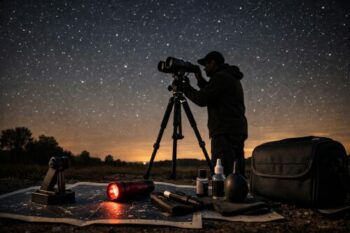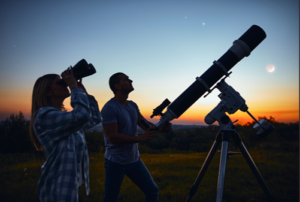
If your curiosity about the night sky first began with a casual glance through an old pair of binoculars… you’re not alone. Many amateur astronomers start exactly this way.
If you’re just getting started, binoculars are often easier to use than telescopes — but this How To Buy A Telescope – A Beginner’s Guide will help you understand when a telescope might be the better choice.
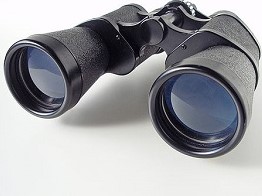
Binoculars are one of the most affordable and user-friendly tools for exploring the stars. They offer bright, sharp views of celestial objects — often revealing details you’d never notice with the naked eye.
With a good-quality pair, you can enjoy crisp views of the Moon, bright planets, star clusters, nebulae, and even some galaxies.
Also unlike telescopes, binoculars are lightweight, easy to store, and simple to use, making them ideal for beginners and travellers alike.
This post breaks down the best binoculars for stargazing, covering a range of budgets and experience levels.
You can also explore the basics of stargazing in our Astronomy for Beginners guide, where we cover everything you need to start observing the night sky.
Disclosure: This post contains affiliate links. If you buy through these links, I may earn a small commission at no extra cost to you. As an Amazon Associate, I earn from qualifying purchases.

Why Choose Binoculars for Stargazing?
If you’re just starting out, binoculars are often a better choice than a telescope — and not just because they’re cheaper.
Here’s why:
- Easy to Use – No setup, no alignment, no learning curve. Just point and look.
- Wide Field of View – Perfect for scanning the Milky Way and large star clusters that don’t fit in most telescopes.
- Portable & Lightweight – Ideal for travel, quick sessions, or spontaneous stargazing.
- Affordable Entry Point – High-quality binoculars cost far less than most telescopes.
- Versatile – Great for wildlife, sports, and daytime use as well as astronomy.
For many people, binoculars aren’t just a beginner tool — they remain a lifelong companion for relaxed, wide-field observing.
If you later decide to upgrade, our guide to the Best Tabletop Telescopes for Beginners is a great next step from binoculars.
What Can You See with Binoculars?
You might be surprised just how much the night sky reveals through a good pair of binoculars.
Here are some of the highlights:
The Moon
Craters, mountain ranges, and shadows along the terminator (the line between light and dark) are clearly visible — even with small binoculars.
Planets
- Jupiter – See its four largest moons (Io, Europa, Ganymede, Callisto)
- Saturn – Appears as an oval shape (rings hinted at in higher magnification)
- Venus – Shows phases like the Moon
Star Clusters
- Pleiades (M45) – A stunning cluster of bright blue stars
- Beehive Cluster (M44) – Beautiful in wide-field views
- Double Cluster (Perseus) – One of the best binocular targets
Nebulae
- Orion Nebula (M42) – A glowing cloud of gas and dust, visible even in light pollution
The Milky Way
From a dark location, binoculars transform the Milky Way into a dense river of stars, packed with detail.
Galaxies
- Andromeda Galaxy (M31) – Visible as a faint elongated glow, even from suburban skies
Tip: The darker your sky, the more you’ll see. Even the best binoculars benefit hugely from getting away from city lights.
What to Look for in Stargazing Binoculars
It’s tempting to assume that the biggest, most powerful binoculars are always best — but that’s not the case.
Here are the key factors to consider:
1. Magnification & Aperture
Binoculars are described by two numbers, such as 10×50.
- 10× = magnification
- 50mm = objective lens diameter (light-gathering ability)
Tip: Higher magnification shows more detail but narrows the field of view and increases shake. Larger objective lenses gather more light but add weight.
Typical astronomy-friendly sizes: 7×50, 8×42, 10×50 (most popular), 15×70 (tripod recommended)
Understanding how magnification affects what you see is key — our Telescope Eyepiece Magnification Explained guide breaks this down clearly.
2. Weight
Big lenses = heavier binoculars.
If they’re too heavy to hold steady, you may need a tripod, which reduces portability.
3. Light-Gathering Ability
50mm and up objective lenses capture more light, making faint objects clearer and brighter.
4. Eye Relief
Important for eyeglass wearers. Look for 15–20mm of eye relief if you wear glasses.
5. Prism Type & Coatings
- BaK-4 prisms = better clarity and brightness
- Fully multi-coated lenses = best light transmission
Check out Binoculars for Stargazing-A Beginners Guide for a more in-depth look the different binocular styles, and how to choose the best binoculars for your needs.
Details of the Top Picks – Best Stargazing Binoculars
Gosky HD Roof Prism Binoculars
Opticron Adventurer T WP Binoculars
Celestron Skymaster Pro Binoculars
1. Celestron Cometron 7×50 – Best Budget
The Celestron Cometron 7×50 offers excellent performance for a very low price, making it one of the best entry-level options for adults and children alike. The 7× magnification provides a wide, steady field of view — perfect for scanning the Milky Way, spotting star clusters, and enjoying bright lunar views.
Choosing the right specifications is important — especially magnification — which is explained in detail in our Telescope Eyepiece Magnification Explained guide.


Key Specifications
| Model Name / Number : | Celestron Cometron Binoculars / 71198 |
| Magnification / Aperture : | 7 x 50 |
| Prism Type : | Porro (BK7) |
| Optics: | Multi-coated |
| Exit Pupil : | 7.1 mm |
| Eye Relief : | 13 mm |
| Weight: | 774g |
| Rating : | ★★★★☆ 9.7/10 |
What We Like
- Wide field of view ideal for beginners
- Excellent low-light performance
- Lightweight and easy to hold
- Very affordable
What Could Be Better
- Eye relief is short for eyeglass wearers
- “Water-resistant” — not fully waterproof
Conclusion
These binoculars deliver bright, wide, steady views — ideal for newcomers, families, and casual stargazers. Considering the small price tag, the optical quality is outstanding. A perfect introduction to astronomy.
Back To “Details Of The Top Picks”
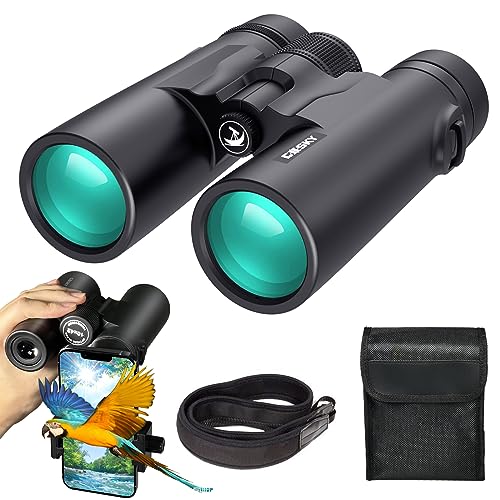
2. Gosky HD 10×42 Roof Prism – Best Lightweight
The Gosky 10×42 delivers excellent value and versatility. With fully multi-coated optics and BaK-4 prisms, they provide crisp, contrast-rich images that outperform many other binoculars at this price point. They’re also extremely portable and comfortable to hold.
Key Specifications
| Model Name / Number : | Gosky HD Roof Prism Binoculars / 4331882459 |
| Magnification / Aperture : | 10 x 42 |
| Prism Type : | Roof (BaK4) |
| Optics: | Fully multi-coated |
| Exit Pupil : | 4.2 mm |
| Eye Relief : | 12 mm |
| Weight : | 700g |
| Rating : | ★★★★☆ 9.7/10 |
What We Like
- Excellent optical quality for the price
- Lightweight and travel-friendly
- Rain-proof and fog-proof
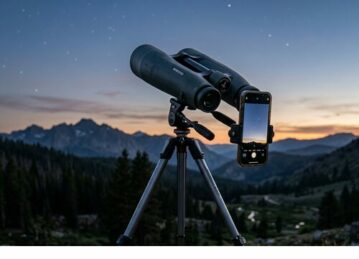
- Includes smartphone adaptor
What Could Be Better
- Eye relief is short for people wearing glasses
- 42mm aperture isn’t as bright as a 50mm option
Conclusion
The Gosky 10×42 is an ideal binocular for mixed use — astronomy, wildlife, travel, and sports. If you love versatility and sharp optics without extra weight, this is a superb choice.

Back To “Details Of The Top Picks”
3. Opticron Adventurer T WP 10×50 – Best Overall Value
The Opticron Adventurer T WP 10×50 is widely considered one of the best budget 10×50 binoculars available today. With BaK-4 prisms, excellent coatings, long eye relief, and a waterproof body, they offer premium features at a mid-range price.
While binoculars are great for wide-field views, you’ll need a telescope for higher magnification — see our guide to the Best Reflector Telescopes for Beginners for more powerful options.

Key Specifications
| Model Name / Number : | Opticron Adventurer T WP Binoculars / 30689 |
| Magnification / Aperture : | 10 x 50 |
| Prism Type: | Porro (BaK-4) |
| Optics: | Fully multi-coated |
| Exit Pupil : | 5 mm |
| Eye Relief : | 18 mm |
| Weight : | 759g |
| Rating : | ★★★★★ 9.8/10 |
What We Like
- Superb light-gathering ability
- Long eye relief – perfect for eyeglass wearers
- Waterproof and durable
- Excellent optical clarity
What Could Be Better
- Slightly bulkier than roof-prism designs
Conclusion
These binoculars hit the sweet spot between price, performance, and build quality. If you want the best all-round astronomy binoculars without spending a fortune, this is the top pick.

Back To “Details Of The Top Picks”
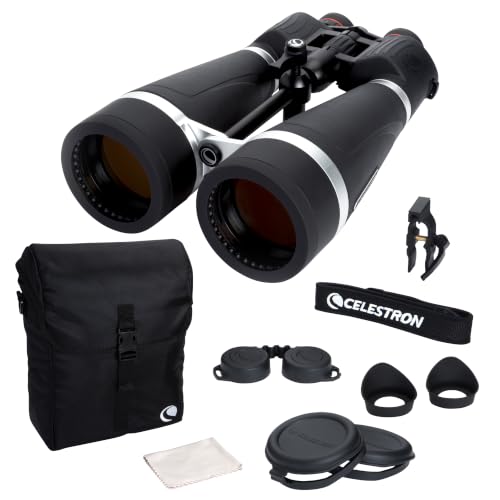
4. Celestron SkyMaster Pro 20×80 – Best High Power
The Celestron SkyMaster Pro 20×80 is designed for serious stargazers who want incredible detail and closer views of star clusters, nebulae, and even galaxies. However — these are big binoculars, and you absolutely will need a tripod to use them effectively.
Key Specifications
| Model Name / Number : | Celestron SkyMaster Pro Binoculars / 72031 |
| Magnification / Aperture : | 20 x 80 |
| Prism Type : | Porro (BaK-4) |
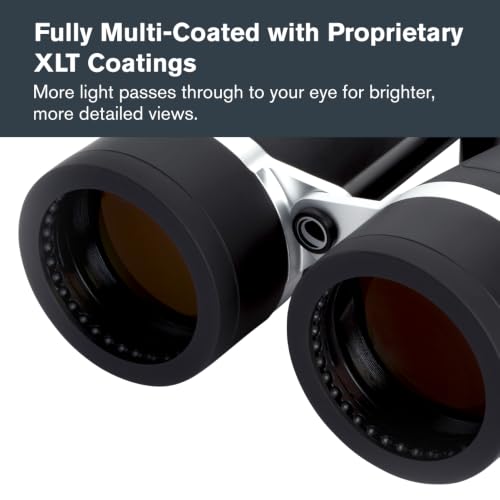
| Optics: | Fully multi-coated (Celestron XLT) |
| Exit Pupil : | 4mm |
| Eye Relief : | 15.5 mm |
| Weight : | 2.27kg |
| Rating : | ★★★★★ 9.8/10 |
What We Like
- Huge 80mm aperture — phenomenal light gathering
- Excellent long-distance detail
- Waterproof and fog-proof
- Premium optical coatings
What Could Be Better
- Needs a tripod (too heavy for handheld use)
- Not suited for beginners or children
Conclusion
If you’re excited by the idea of seeing the deep sky in much greater detail — and you’re okay using a tripod — the SkyMaster Pro 20×80 offers breathtaking performance.
Back To “Details Of The Top Picks”
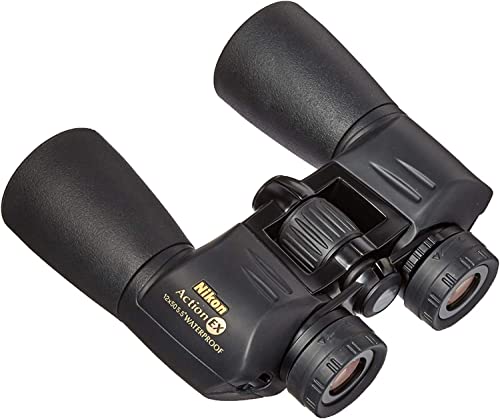
5. Nikon Action EX 12×50 – Best Handheld High Magnification
The Nikon Action EX 12×50 is a great choice if you want a bit more reach in a rugged, well-built package. With 12× magnification and 50mm objectives, these deliver excellent detail on the Moon and planets — but they’re still usable handheld for short sessions, and can be tripod-mounted for steady long observing.
Alternatively, refractor telescopes are known for their sharp, high-contrast views — explore our guide to the Best Refractor Telescopes for Beginners.

Key Specifications
| Model Name / Number : | Nikon Action EX 12 x 50 CF Binocular / 7246 |
| Magnification / Aperture : | 12 x 50 |
| Prism Type : | Porro (BaK-4) |
| Optics : | Multi-coated (dielectric, high-reflective multilayer coatings) |
| Exit Pupil : | 4.2 mm |
| Eye Relief : | 16.1 mm |
| Weight : | 1.020 kg |
| Rating : | ★★★★★ 9.8/10 |
What We Like
- Strong 12× magnification for more detailed lunar and planetary views
- High-quality BaK-4 prisms and advanced coatings for excellent contrast and brightness
- Long eye relief and high-eye-point design — comfortable for eyeglass wearers
- Robust, shock-resistant rubber armouring and weather-sealing (nitrogen-filled)
What Could Be Better
- Heavier than 10× models — can tire the arms during extended handheld use
- Exit pupil is smaller than 50mm/7x options, so less forgiving in very dark skies or for older eyes
Conclusion
If you want extra magnification without sacrificing optical quality, the Nikon Action EX 12×50 is an outstanding choice. It’s built to last, comfortable for eyeglass wearers, and performs especially well on the Moon, planets, and tighter deep-sky objects when mounted on a tripod.
Back To “Details Of The Top Picks”
Final Thoughts
Buying binoculars is one of the simplest and most affordable ways to begin your astronomy journey. Whether you’re scanning the Milky Way or exploring lunar craters, there’s a perfect pair for every budget and experience level.
Top Recommendations:
- Best Budget: Celestron Cometron 7×50
- Best Lightweight: Gosky 10×42
- Best Overall Value: Opticron Adventurer T WP 10×50
- Best High-Power: Celestron SkyMaster Pro 20×80
- Best Handheld High Magnification: Nikon Action EX 12×50
If you decide to expand your setup, you may also want to explore our Telescope Accessories Guide for upgrades like eyepieces and Barlow lenses.
Ready to explore the night sky? A great pair of binoculars is the perfect place to start.
FAQ — Binoculars for Stargazing
1. Are binoculars good for stargazing?
Yes! Binoculars are one of the best ways to start exploring the night sky. They’re inexpensive, easy to use, and offer wide, bright views ideal for the Moon, star clusters, the Milky Way, and even some nebulae.
2. What magnification is best for astronomy binoculars?
For beginners, 7×50 and 10×50 are ideal because they offer bright, steady views while still being easy to hold. Higher magnifications like 12×50 or 20×80 provide more detail but usually need a tripod.
3. Do I need a tripod for stargazing with binoculars?
It depends on the magnification. Anything above 12× will show hand shake. Models like 20×80 absolutely require a tripod, but 7×50 and 10×50 are fine handheld.
4. Can I see planets with binoculars?
Yes. You can easily see the Moon’s craters, Jupiter’s four largest moons, Saturn’s oval shape, the Pleiades, Orion Nebula, and many star clusters. Higher-power models reveal even more planetary detail.
5. Which binocular size is best for light pollution?
If you live under streetlights or suburban skies, go for 10×50 or larger. The bigger 50–80 mm objectives gather more light and help reveal faint objects that get washed out by light pollution.