If you’re taking your very first steps into astronomy, a refractor telescope is one of the safest and most rewarding places to start.
Refractors are simple to use, low-maintenance, and deliver crisp, contrast-rich views of the Moon, planets, and bright deep-sky objects.
They’re the kind of telescope that lets beginners focus on observing — not fiddling with collimation or complex setups.
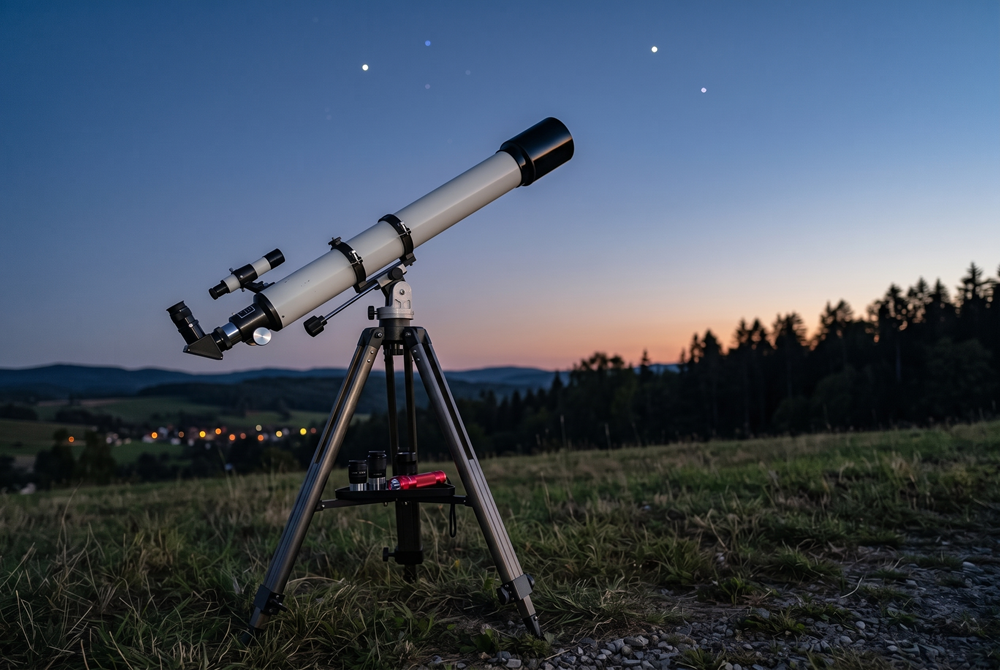
In this guide, I’ll explain why refractor telescopes are ideal for beginners, what to look for before buying, and which models offer the best balance of performance, ease of use, and value.
Note: This post contains affiliate links. If you buy through these links, I may earn a small commission at no extra cost to you. As an Amazon Associate, I earn from qualifying purchases.
Quick Verdict (If you’re short of time)
- Best budget-friendly starter: Celestron AstroMaster 70AZ — lightweight, simple, and ideal for first-time users.
- Best balance of quality and simplicity: Sky-Watcher Evostar 90 AZ — excellent optics and a very stable mount.
- Best overall beginner refractor: Celestron Inspire 100AZ — brightest views and the most room to grow.
If you’re unsure which to choose, start with the Inspire 100AZ — it delivers the most noticeable improvement in what you’ll actually see.
Why Refractor Telescopes Work So Well for Newcomers
Refractors use lenses rather than mirrors to gather and focus light. This design offers several advantages that are especially helpful when you’re just starting out.
Key Benefits of Refractor Telescopes
- Sharp, high-contrast views — ideal for the Moon and planets
- No collimation required — they stay aligned out of the box
- Minimal maintenance — no mirrors to adjust or clean
- Quick setup — perfect for short observing sessions
For beginners, this means less frustration and more time enjoying the night sky.
The Best Refractor Telescopes for Beginners
Below are the top recommendations, selected for ease of use, optical quality, stability, and overall value.
Celestron AstroMaster 70AZ
Best for: Beginners who want simplicity and planetary viewing.
The Celestron AstroMaster 70AZ is a lightweight, beginner-friendly refractor that delivers crisp, high-contrast views of the Moon and bright planets.
Its simple alt-azimuth mount and quick setup make it an easy, confidence-building first telescope.


Key Specs
- Aperture: 70mm
- Focal length: 900mm
- Mount: Alt-azimuth
What You’ll See
- Detailed lunar surface
- Jupiter’s moons
- Saturn’s rings under steady skies
Pros
- Very easy to use
- Good planetary contrast
- Lightweight and portable
Cons
- Mount could be sturdier
- Limited deep-sky performance
Sky-Watcher Evostar 90
Best for: Beginners who want premium optics with minimal learning curve.
The Sky-Watcher Evostar 90 is known for its sharp optics and rock-solid alt-azimuth mount.
It offers bright, high-contrast views of the Moon, planets, and star clusters — perfect for beginners who want quality without complexity.

Key Specs
- Aperture: 90mm
- Focal length: 900mm
- Mount: Alt-azimuth
What You’ll See
- Razor-sharp lunar craters
- Jupiter’s cloud bands
- Bright open star clusters
Pros
- Excellent optical quality
- Very stable mount
- Strong upgrade potential
Cons
- Slightly heavier than entry models
- Higher price than basic starters
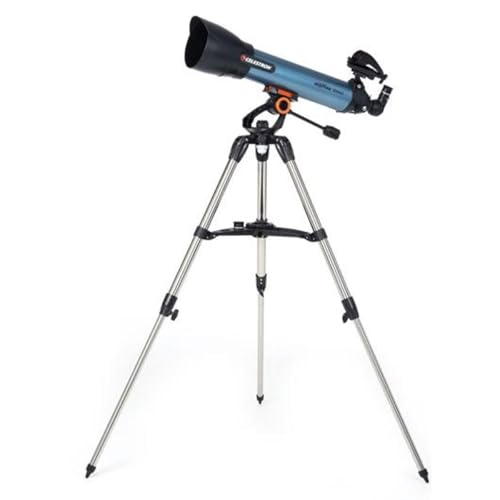
Celestron Inspire 100AZ
Best for: Beginners who want the brightest refractor with room to grow.
The Celestron Inspire 100AZ combines a bright 100mm aperture with beginner-friendly design features, including an integrated smartphone holder.
It delivers wide, immersive views of the Moon, planets, and bright deep-sky objects.
Key Specs
- Aperture: 100mm
- Focal length: 660mm
- Mount: Alt-azimuth
What You’ll See
- Highly detailed lunar views
- Saturn’s rings
- Bright nebulae under dark skies
Pros
- Brightest views of the three
- Integrated smartphone holder
- Easy assembly
Cons
- Basic focuser and mount
- Some colour fringing at high power
Beginner Refractor Telescope Comparison Table
| Telescope | Aperture | Focal Length | Mount Type | Best For | Skill Level |
|---|---|---|---|---|---|
| Celestron AstroMaster 70AZ | 70mm | 900mm | Alt-Azimuth | Moon, planets, portability | Absolute beginner |
| Sky-Watcher Evostar 90 AZ | 90mm | 900mm | Alt-Azimuth | Sharp planetary views, stability | Beginner–Intermediate |
| Celestron Inspire 100AZ | 100mm | 660mm | Alt-Azimuth | Bright views, all-round observing | Beginner |
How to Read This Table
- Aperture: Bigger = brighter and more detailed views
- Focal length: Longer = easier high magnification, shorter = wider views
- Mount type: All are beginner-friendly alt-az mounts
- Best for: Helps match the telescope to how you’ll actually use it
What to Look for in Your First Refractor Telescope
Before choosing a specific model, it helps to understand a few basic terms.
Aperture (Lens Diameter)
Aperture determines how much light the telescope gathers.
- 60–70mm: Entry-level; best for the Moon and bright planets
- 70–90mm: The ideal beginner sweet spot
- 90mm+: Brighter views, but larger and heavier
For most beginners, 70–80mm is ideal.
Focal Length & Focal Ratio
- Longer focal lengths provide higher magnification and are more forgiving with eyepieces
- Shorter focal lengths give wider views and make tracking objects easier
A focal ratio around f/10 is very beginner-friendly and helps reduce colour fringing.
Mount Type (Very Important)
A good mount matters just as much as the telescope itself.
- Alt-azimuth mounts: Simple, intuitive, and beginner-friendly
- Equatorial mounts: Better for tracking, but require learning
For most newcomers, an alt-az mount is the right choice.
Chromatic Aberration (Colour Fringing)
Some beginner refractors may show a slight purple or blue fringe around bright objects like the Moon at high magnification.
This is normal in affordable refractors and doesn’t prevent excellent views while learning the night sky.
What Can You Realistically See With a Beginner Refractor?
With a beginner refractor telescope, you can expect to see:
- The Moon in stunning detail
- Jupiter’s moons and cloud bands
- Saturn’s rings
- Venus’ phases
- Bright star clusters like the Pleiades
You won’t see colourful nebulae or galaxies like astrophotography images — but what you do see is real, detailed, and incredibly rewarding.
If portability is important, you may also enjoy The Best Binoculars for Stargazing, which offers wide-field views with minimal setup.
Common Beginner Mistakes to Avoid
- Choosing magnification over aperture
- Buying an unstable mount
- Expecting astrophotography-style views
- Observing without letting your eyes dark-adapt
- Giving up too quickly
Astronomy rewards patience — and even a modest refractor can deliver unforgettable views.
Frequently Asked Questions
The Celestron Inspire 100AZ is the best refractor for absolute beginners. It offers bright, clear views, a simple alt-az mount, and quick setup, making it easy to start observing the Moon, planets, and bright deep-sky objects.
Yes, refractor telescopes are excellent for viewing planets. They produce sharp, high-contrast images of the Moon, Jupiter, Saturn, and Venus, and require no collimation, making them one of the easiest telescope types for beginners to use.
Beginners should choose a refractor telescope with an aperture between 70mm and 90mm. This size provides a good balance of brightness, image sharpness, and portability while remaining easy to set up and use.
Refractor telescopes require very little maintenance. They do not need collimation and usually stay aligned for years, making them a low-maintenance and beginner-friendly option compared to reflector telescopes.
Yes, beginner refractor telescopes can show bright deep-sky objects such as the Orion Nebula and the Pleiades. While views are subtle compared to astrophotography, they are detailed and rewarding under dark skies.