Choosing your first telescope can feel overwhelming, especially when you’re faced with unfamiliar terms like aperture, focal length, and equatorial mounts.
If you’re completely new to telescopes, our How To Buy A Telescope – A Beginner’s Guide will help you understand the key differences before choosing your first scope.
For beginners, reflector telescopes are often the best place to start. They offer excellent light‑gathering power for the price, deliver impressive views of the Moon and planets, and truly shine when exploring deep‑sky objects like nebulae and star clusters.
This guide explains exactly what to look for in a reflector telescope for beginners, followed by carefully chosen recommendations that balance performance, ease of use, and value for money.
You can also explore the basics of stargazing in our Astronomy for Beginners guide, where we cover everything you need to get started.

Note: This post contains affiliate links. If you buy through these links, I may earn a small commission at no extra cost to you. As an Amazon Associate, I earn from qualifying purchases.
Quick Verdict (If you’re short of time)
- Best overall: Celestron AstroMaster 114EQ
- Best budget option: Celestron PowerSeeker 114EQ
- Best simple, beginner option: Seben 76/700 AZ reflector
In a hurry? If you want the best balance of performance and long‑term usability, the Celestron AstroMaster 114EQ is the strongest all‑round choice for most beginners.
Why Choose a Reflector Telescope as a Beginner?
Reflector telescopes use mirrors instead of lenses to collect and focus light. This simple design gives beginners several key advantages:
- More aperture for your money – larger mirrors mean brighter, more detailed views
- Excellent for deep‑sky observing – nebulae, galaxies, and star clusters stand out
- No chromatic aberration – no colour fringing common in budget refractors
For beginners who want the biggest visual impact without overspending, reflectors are hard to beat.
To get the most out of these views, pairing your telescope with the right eyepieces makes a big difference — see our guide to the Best Telescope Eyepieces For Stargazing.
The Best Reflector Telescopes for Beginners
Celestron AstroMaster 114EQ
Best for: Beginners who want sharp planetary views and room to grow
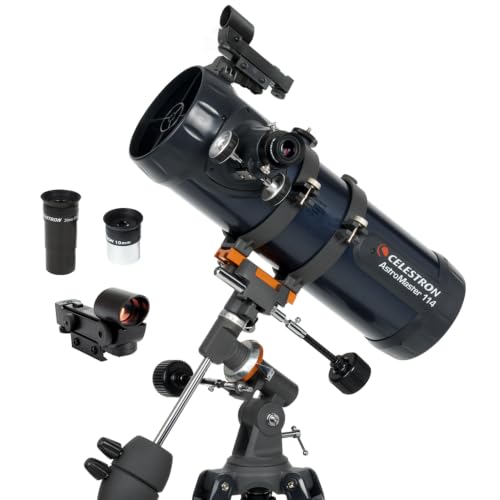
The AstroMaster 114EQ is a classic beginner reflector with a generous 114mm aperture. It delivers crisp views of the Moon, Saturn’s rings, and Jupiter’s cloud bands, while still handling brighter deep‑sky targets.

Key specifications:
- Aperture: 114mm
- Focal length: 1000mm
- Mount: German equatorial
Pros:
- Excellent optics for the price
- Long focal length suits planetary observing
- Solid build quality
Cons:
- Equatorial mount takes some learning
- Slower setup than alt‑az designs
Verdict: A strong step‑up beginner telescope with real observing potential.
You can also increase magnification affordably by adding one of the options in our guide to the Best Barlow Lens For Your Telescope.
Celestron PowerSeeker 114EQ
Best for: Budget‑conscious beginners who want versatility
The PowerSeeker 114EQ is one of the most popular beginner reflectors. It offers a good aperture, useful accessories, and respectable performance at an affordable price.
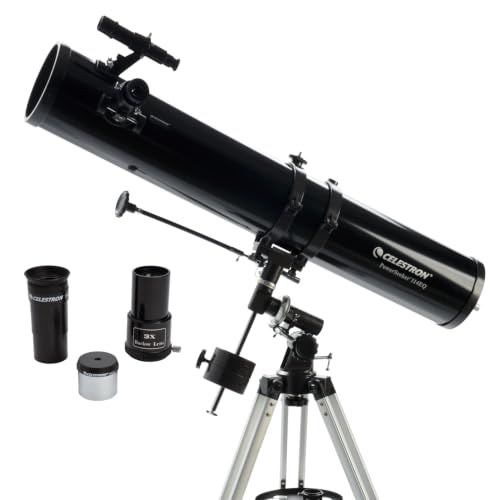
Key specifications:
- Aperture: 114mm
- Focal length: 900mm
- Mount: Equatorial
Pros:
- Very good value for money
- Capable of lunar, planetary, and some deep‑sky viewing
- Includes multiple eyepieces
Cons:
- Mount stability could be better
- Accessories are basic
Verdict: A solid entry‑level reflector that introduces you to serious astronomy without a large investment.
Seben 76/700 Reflector
Best for: Beginners looking for an affordable all-round reflector
With a smaller 76mm aperture, this telescope is lightweight, unintimidating, and easy to use, making it a good first step into astronomy.

Key specifications:
- Aperture: 76mm
- Focal length: 700mm
- Mount: Alt- azimuth
Pros:
- Best for: Beginners looking for a simple all-round reflector
- Long 700mm focal length for lunar and planetary viewing
- Includes several eyepieces and a Barlow lens
- Affordable entry point
Cons:
- Limited deep-sky performance compared with larger reflectors
- Not ideal for astrophotography
Verdict: A compact and affordable reflector that gives beginners a straightforward introduction to observing the Moon and planets.
Quick Comparison: Beginner Reflector Telescopes
| Telescope | Best For | Aperture | Mount | Skill Level |
|---|---|---|---|---|
| Celestron AstroMaster 114EQ | Planetary & lunar views | 114mm | Equatorial | Beginner–Intermediate |
| Celestron PowerSeeker 114EQ | Budget all‑rounder | 114mm | Equatorial | Beginner |
| Seben 76/700 Reflector | Younger users / first scope | 76mm | Alt Azimuth | Absolute beginner |
What to Look for in a Beginner Reflector Telescope
Aperture (The Most Important Specification)
Aperture is the diameter of the primary mirror. The larger it is, the more light the telescope gathers.
- 76–114mm: Good for the Moon and planets
- 114–150mm: Excellent all‑round beginner range
- 150mm+: Outstanding views, but larger and heavier
If you remember just one thing: aperture matters more than magnification. This is something explained clearly in our Telescope Eyepiece Magnification Explained guide.
Mount Type
The mount determines how easy the telescope is to use.
- Alt‑azimuth mounts: Simple up/down, left/right movement (best for beginners)
- Equatorial mounts: Designed for tracking objects but have a steeper learning curve
Many beginner reflectors come with equatorial mounts, but a solid alt‑az or Dobsonian base is often easier and more enjoyable.
Portability and Setup
Choose a telescope that’s easy to carry and quick to set up. A smaller scope that’s used often will always beat a larger telescope that stays indoors.
If portability is a concern, compact options like our guide to the Best Tabletop Telescopes for Beginners are worth considering.
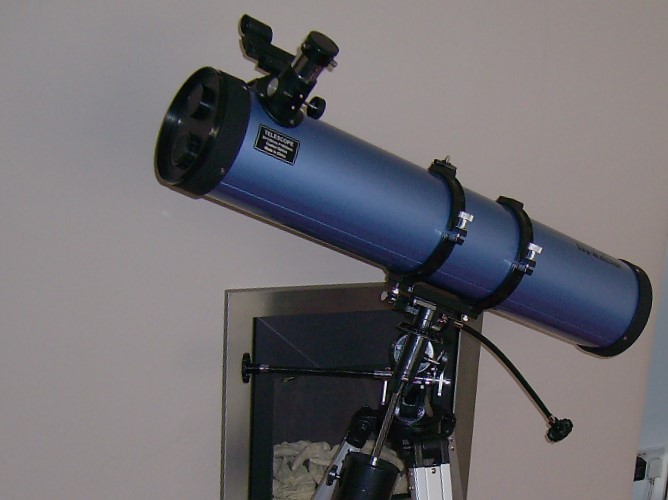
What Can You See with a Beginner Reflector?
Even with a modest reflector telescope, you can observe:
- Craters and mountain ranges on the Moon
- Saturn’s rings and Jupiter’s moons
- Phases of Venus and Mars at opposition
- Bright nebulae like the Orion Nebula
- Open star clusters such as the Pleiades
Under darker skies, larger apertures will reveal even more detail.
Learning what to expect from your telescope is key — our Beginner Stargazing Guide explains how to get the best views of planets and deep-sky objects.
Are Reflector Telescopes Hard to Maintain?
Reflectors require occasional collimation to keep the mirrors aligned. Modern beginner telescopes make this relatively simple, and it’s a small trade‑off for the performance you gain.
Beginners looking for simpler, low-maintenance setups may prefer one of our best refractor telescopes for beginners instead.
Final Verdict: Which Beginner Reflector Should You Choose?
- Best overall beginner reflector: Celestron AstroMaster 114EQ
- Best budget option: Celestron PowerSeeker 114EQ
- Best for kids and first‑time users: Seben 76/700
If you want the most impressive views for your money and don’t mind a short learning curve, a 114mm reflector is the sweet spot for beginners.
To get the most from your new telescope, you’ll also want to explore our Telescope Accessories Guide for essential upgrades like eyepieces and Barlow lenses.
Frequently Asked Questions
Yes, reflector telescopes are excellent for beginners. They offer larger apertures for the price, brighter views of planets and deep-sky objects, and no colour fringing, making them ideal for learning astronomy without spending a lot of money.
A beginner should choose a reflector telescope with a 114mm aperture. This size provides a strong balance of brightness, detail, and portability, allowing clear views of the Moon, planets, and bright deep-sky objects without becoming bulky or difficult to use.
Equatorial mounts have a short learning curve but are manageable for beginners. Once aligned, they make tracking planets and stars easier than simple mounts, which is why many beginner reflector telescopes include them.
With a beginner reflector telescope, you can see lunar craters, Saturn’s rings, Jupiter’s moons, bright nebulae like Orion, and open star clusters. Larger beginner apertures reveal more detail, especially when observing from darker skies.
Reflector telescopes require occasional collimation to keep the mirrors aligned. This is a simple process for beginner models and is a small trade-off for the brighter views and better value reflectors provide.