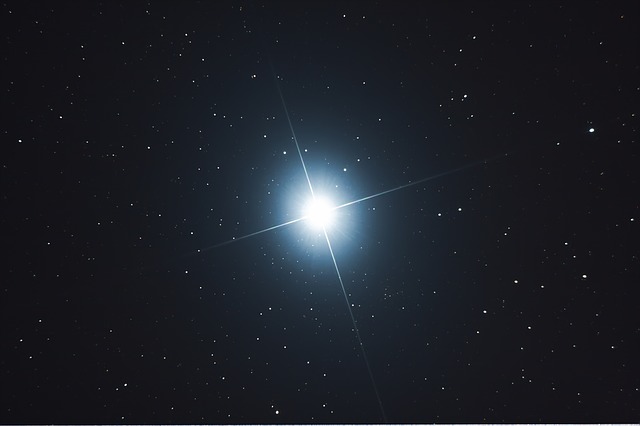
If you have ever looked up at the night sky and noticed stars shimmering, flickering or flashing different colours, you have already witnessed one of astronomy’s most familiar effects. Many beginners quickly start wondering, why do stars twinkle so noticeably compared to planets?
Understanding why stars twinkle is surprisingly useful for amateur astronomers. Once you know what causes the effect, you can better judge viewing conditions, improve telescope observations and even identify planets more easily in the night sky.
Whether you are observing with your eyes, binoculars or a telescope, learning about twinkling helps you become a more confident skywatcher.
TL;DR – Quick Answer
Stars twinkle because Earth’s atmosphere bends and distorts incoming starlight.
This effect is called atmospheric turbulence or astronomical scintillation.
Planets usually twinkle less because they appear slightly larger in the sky, so the atmospheric distortions average out across their visible surface.
What Does Twinkling Actually Mean?
When astronomers talk about stars twinkling, they mean that stars appear to:
- rapidly change brightness
- slightly shift position
- flicker or shimmer
- flash subtle colours like red, blue or white
Importantly, the stars themselves are not actually flickering. The effect happens much closer to home — inside Earth’s atmosphere.
Why Do Stars Twinkle?
Even though stars are enormous, they are so incredibly far away that they appear as tiny points of light in the sky. Your eyes — and even most amateur telescopes — cannot see them as visible discs.
Understanding the incredible distances to stars helps explain why they appear as tiny points of light in the sky, which is why learning what is a light year can make stargazing even more fascinating.
In the Earth’s atmosphere, tiny pockets of moving air, known as atmospheric turbulence, constantly distort the light. This causes stars to appear to dance, brighten, dim, and even change colour for brief moments.
A good analogy is looking at a coin at the bottom of a swimming pool. If the water is calm, the coin looks steady and clear. But if the water ripples, the coin seems to wobble and shimmer. Earth’s atmosphere behaves in a similar way for starlight.
This is the foundation of stars twinkling explained in simple terms: moving air bends light unpredictably.
Atmospheric Turbulence Explained
The main cause of twinkling is atmospheric turbulence.
Earth’s atmosphere is made of constantly moving layers of air with different:
- temperatures
- densities
- pressures
As starlight passes through these shifting layers, the light bends slightly in different directions. This bending changes from moment to moment, causing the star to appear unstable.
Astronomers refer to this effect as astronomical scintillation.
How Moving Air Changes Starlight
Imagine shining a flashlight through rising heat above a road on a hot day. The light appears wavy and distorted because hot and cool air bend the light differently.
The same thing happens to starlight.
As the atmosphere shifts:
- the star may briefly appear brighter
- then dimmer
- slightly displaced
- or even tinted with colour
This constant bending creates the sparkling appearance we call twinkling.
Why Stars Twinkle More Near the Horizon
You may notice that stars closer to the horizon twinkle much more strongly than stars overhead.
That happens because their light must travel through far more atmosphere before reaching you.
Near the horizon, starlight passes through thicker layers of turbulent air, increasing distortion dramatically.
This is why bright low stars can appear to flash wildly with different colours.
Bright Stars Often Show Strong Twinkling
Some bright stars make the effect especially obvious.
Examples include:
- Sirius
- Betelgeuse
- Vega
For example, Sirius often flashes red, blue and white rapidly when viewed low in the sky because its bright light is strongly distorted by atmospheric turbulence.
This makes it one of the most dramatic examples of why stars flicker.
If you are new to astronomy and want to explore the night sky for yourself, our guide on How to Start Stargazing covers the essential tips and equipment beginners need.
Why Don’t Planets Twinkle as Much?
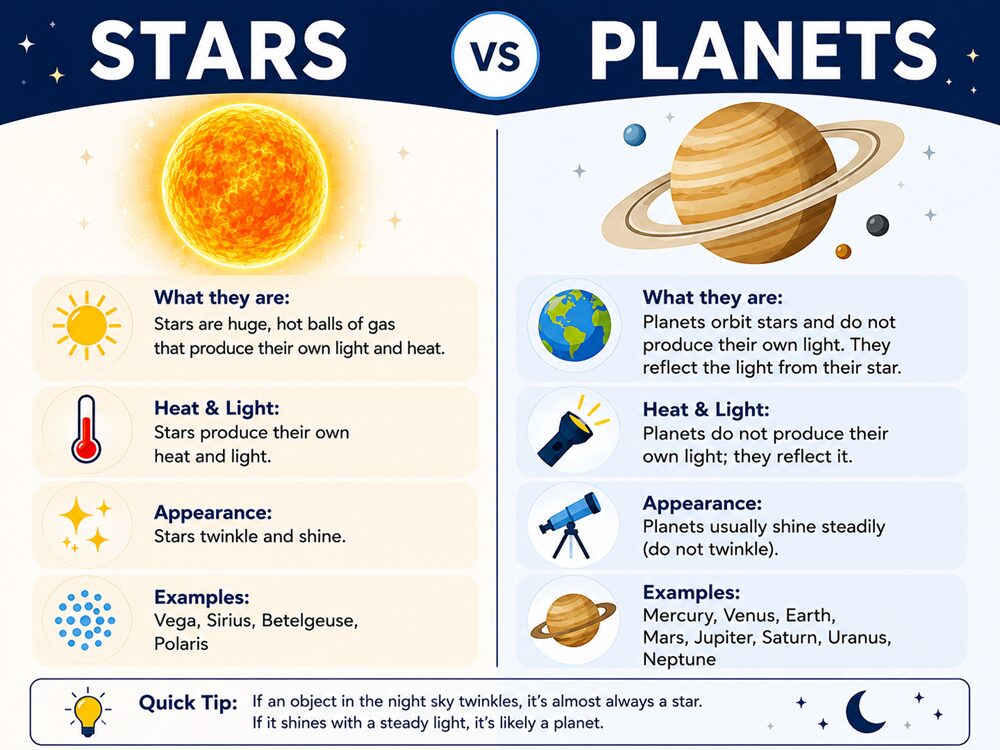
One of the easiest ways to identify planets is that they usually shine more steadily than stars.
Planets Appear as Tiny Discs
Unlike stars, planets are much closer to Earth. Through the atmosphere, they appear as tiny discs rather than perfect points of light.
Even though those discs are still very small, they are large enough that atmospheric distortions average out across their surface.
Instead of flickering sharply, planets usually maintain a steadier glow.
Jupiter and Saturn Often Look Stable
Planets like:
- Jupiter
- Saturn
- Venus
often appear bright and stable compared to nearby stars.
Venus can occasionally twinkle strongly when very low near the horizon, but most of the time planets shimmer far less than stars.
This difference is a major part of understanding why planets do not twinkle.
Stars vs Planets Comparison
| Feature | Stars | Planets |
|---|---|---|
| Appearance in sky | Tiny points of light | Tiny visible discs |
| Twinkling | Strong and noticeable | Usually mild |
| Brightness changes | Rapid flickering | More stable glow |
| Telescope appearance | Point-like | Visible surface/disc |
| Common beginner confusion | Often mistaken for planets | Often mistaken for bright stars |
Does Twinkling Affect Telescope Viewing?
Absolutely. In astronomy, atmospheric turbulence strongly affects telescope performance.
What Astronomers Mean by “Seeing”
Astronomers use the term seeing to describe how stable the atmosphere is.
- Good seeing = calm atmosphere and sharp views
- Poor seeing conditions = unstable atmosphere and blurry views
Even a powerful telescope cannot overcome poor atmospheric seeing completely.
Why Objects Appear Blurry
On unstable nights:
- stars may appear to dance or wobble
- planets can look soft and blurry
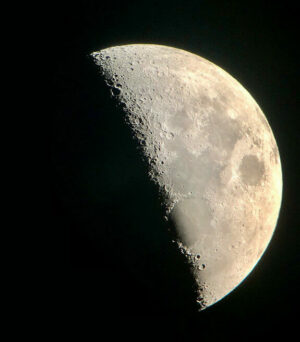
- fine lunar details become harder to see
At high magnifications, the atmosphere behaves almost like moving water above the telescope.
Practical Beginner Examples
When observing:
- Moon
- Jupiter
- Saturn
you may notice:
- Jupiter’s cloud bands ripple or blur
- Saturn’s rings lose sharpness
- lunar craters seem unstable around the edges
On steady nights, however, these objects can appear incredibly crisp and detailed.
This is why experienced astronomers often value atmospheric conditions more than telescope size alone.
Can You Reduce the Effects of Twinkling?
You cannot stop Earth’s atmosphere from moving, but you can reduce how much it affects your observations.
Beginner Tips for Better Viewing
Use this simple checklist:
- Observe objects when they are high overhead
- Avoid viewing near the horizon
- Stay away from rooftops, chimneys and hot surfaces
- Allow your telescope time to cool to outdoor temperature
- Observe during calm, stable weather
- Avoid observing immediately after hot sunny days
- Use lower magnification when the atmosphere is unstable
Why Telescope Cooling Matters
A warm telescope creates its own internal air currents.
If you take a telescope from a warm house into cold night air and observe immediately, rising heat inside the tube can worsen image distortion.
Letting the telescope cool properly can noticeably improve image sharpness.

Fun Facts About Twinkling Stars
Stars Can Flash Different Colours
Bright stars sometimes appear to rapidly flash:
- red
- blue
- green
- white
This happens because atmospheric turbulence bends different wavelengths of light slightly differently.
Astronauts Do Not See Stars Twinkle
In space, there is no atmosphere to distort starlight. That means astronauts see stars as steady points of light without twinkling.
The Scientific Name Is “Astronomical Scintillation”
Scientists call star twinkling:
astronomical scintillation
It sounds technical, but it simply describes atmospheric fluctuations affecting incoming light.
Twinkling Helps Scientists Study the Atmosphere
Astronomers can actually study atmospheric behaviour by measuring scintillation patterns.
The same atmospheric effects that frustrate telescope users also provide useful scientific information.
Helpful Comparison Table
| Feature | Stars | Planets |
|---|---|---|
| Shape in sky | Point source | Tiny disc |
| Twinkling strength | Strong | Weak or minimal |
| Colour flashing | Common in bright stars | Rare |
| Telescope appearance | Sharp points | Small visible discs |
| Best beginner clue | Flickers noticeably | Shines steadily |
Common Beginner Mistakes
Thinking Stars Physically Flicker
The star itself is usually not changing brightness rapidly. The atmosphere is causing the effect.
Confusing Planets With Stars
Many beginners assume bright planets are stars.
A good rule:
- stars twinkle strongly
- planets usually glow steadily
Blaming the Telescope
Beginners sometimes think blurry planetary views mean their telescope is faulty.
Often the real problem is poor atmospheric seeing.
Observing Too Close to the Horizon
Objects low in the sky suffer much heavier atmospheric distortion.
For sharper views, try observing when objects are higher overhead.
Frequently Asked Questions
Cold winter air often contains stronger temperature differences and turbulent air movement, which can increase scintillation effects.
Earth’s atmosphere bends different colours of light slightly differently, causing rapid colour flashes in bright stars.
Twinkling is caused by Earth’s atmosphere. In space, there is no atmosphere to distort starlight.
No. Bright stars near the horizon usually twinkle the most because their light passes through more atmosphere.
Yes. Atmospheric turbulence can reduce image sharpness and blur fine planetary detail in long exposures or high magnification imaging.
Conclusion
Once you understand why stars twinkle, the night sky starts to make much more sense.
What looks like magical flickering is actually the result of Earth’s constantly moving atmosphere bending incoming starlight. This same atmospheric turbulence also explains why planets usually shine more steadily and why telescope views vary from night to night.
For amateur astronomers, learning about twinkling is genuinely useful. It helps you recognise planets, judge observing conditions and understand why some nights provide sharper views than others.
The next time you step outside under a clear sky, take a moment to watch the stars carefully. You will not just see beautiful points of light — you will be witnessing Earth’s atmosphere interacting with the wider universe in real time.