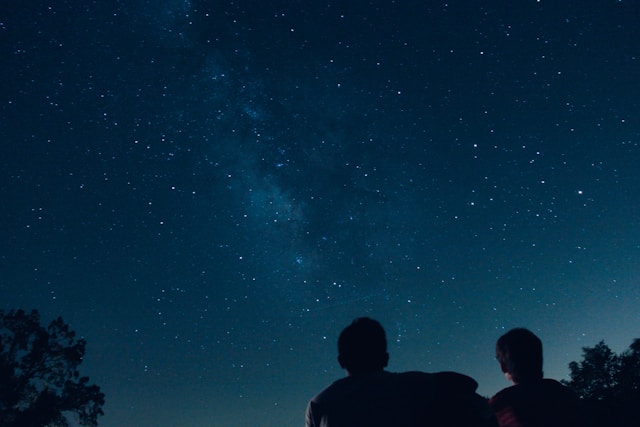
Look up on a clear night and you’ll discover a universe filled with incredible sights. From bright planets and sparkling star clusters to distant galaxies and meteor showers, there’s far more visible above your head than most people realise.
If you’ve ever wondered what can you see in the night sky, the exciting answer is: quite a lot — even without expensive equipment.
Many beginners assume astronomy requires a giant telescope, but some of the most rewarding sights can be enjoyed using only your eyes, a simple pair of binoculars, or a small beginner telescope.
The Moon alone can keep observers fascinated for years, while planets like Jupiter and Saturn are bright enough to spot from many back gardens.
If you’ve ever noticed stars shimmering overhead while planets appear steadier, it helps to understand the science behind why stars appear to twinkle in the night sky.
In This Guide You’ll Discover:
- What you can see with your naked eyes
- Amazing objects visible through binoculars
- What a telescope really shows you
- The easiest beginner stargazing targets
- Seasonal night sky highlights
- How to find objects more easily
- Why light pollution matters
- Practical tips for better observing
Whether you live in the countryside or a city suburb, there’s always something waiting to be discovered overhead.
Why The Night Sky Looks Different Every Night
Before diving into specific night sky objects, it helps to understand that the sky constantly changes.
The Earth rotates every 24 hours, causing stars and planets to appear to move across the sky. At the same time, Earth orbits the Sun, which means different constellations become visible throughout the year.
Weather, moonlight and light pollution also dramatically affect what you can see.
Some nights may reveal thousands of stars and the glowing Milky Way. Other nights may only show the Moon and a handful of bright planets.
That unpredictability is part of what makes astronomy so rewarding.
What Can You See With Your Naked Eyes?
You don’t need a telescope to start exploring astronomy. In fact, some of the most beautiful night sky sights are best enjoyed without one.
The Moon
The Moon is usually the first object beginners observe, and for good reason.
Even with your eyes alone, you can easily notice:
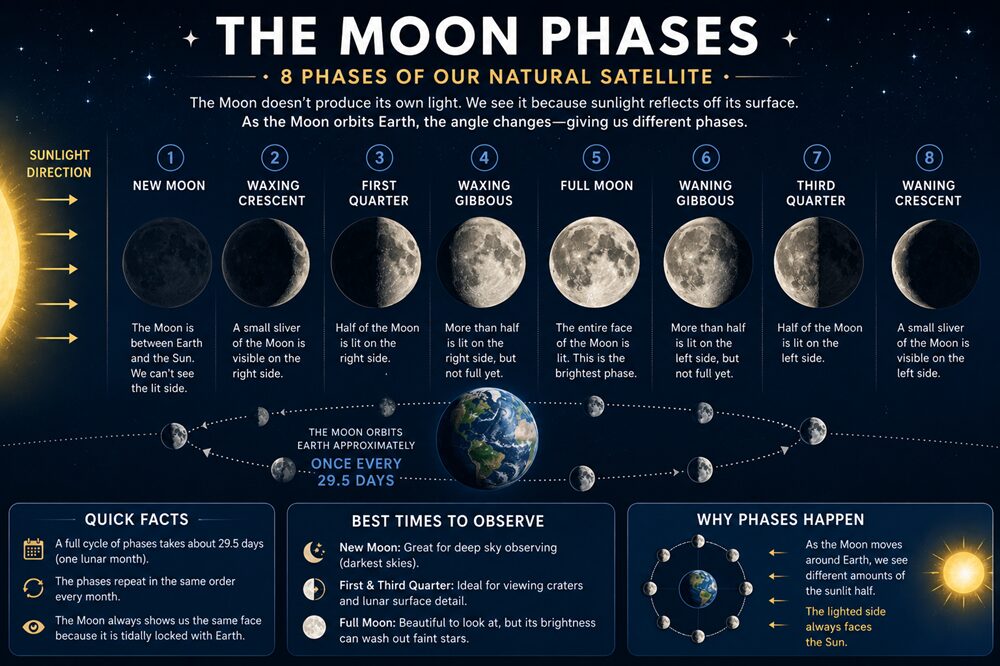
- Different moon phases
- Bright lunar “seas”
- Crescent shapes
- Full Moon brightness
- Occasional lunar eclipses
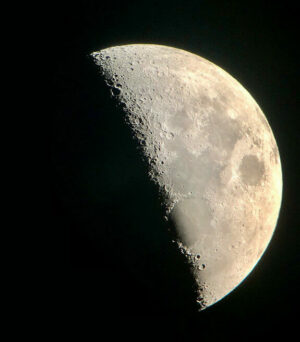
The best time for moon observing is during the crescent or quarter phases. Shadows along the Moon’s edge make craters and mountains stand out far more dramatically than during a Full Moon.
Did You Know?
The Moon is slowly drifting away from Earth at around 3.8 cm per year.
Bright Planets
Several planets are bright enough to spot without any equipment.
The easiest visible planets tonight are often:
- Jupiter
- Venus
- Mars
- Saturn
Venus is usually the brightest and often appears shortly after sunset or before sunrise.
Jupiter shines steadily and can outshine nearly every star in the sky.
Unlike stars, planets usually don’t twinkle much because they appear as tiny discs rather than distant points of light.
Constellations
Constellations are patterns of stars that help astronomers navigate the sky.
Some beginner-friendly constellations include:
- Orion
- Ursa Major
- Cassiopeia
- Scorpius
- Cygnus
Learning constellations is one of the best ways to build confidence in astronomy because they act like signposts for finding deeper sky objects later.
The Milky Way
From a dark location, the Milky Way appears as a faint glowing river stretching across the sky.
This hazy band contains billions of distant stars from our own galaxy.
Sadly, heavy city light pollution often hides it completely.
Seeing the Milky Way for the first time under truly dark skies is unforgettable.
Many of the objects visible above us are unimaginably far away, so learning how astronomers measure vast distances in space can really put the universe into perspective.
Meteors
Meteor showers occur throughout the year when Earth passes through streams of comet debris.
Popular meteor showers include:
- Perseids
- Geminids
- Quadrantids
No telescope is needed. Simply lie back and look upward.
Dark skies make a huge difference.
Satellites And The ISS
Satellites often appear as slowly moving points of light drifting across the sky.
The most impressive is the International Space Station, which can become brighter than most stars.
Unlike aircraft, satellites do not flash.
Bright Stars And Star Colours
Some stars display noticeable colours.
For example:
- Betelgeuse appears reddish
- Rigel looks bluish-white
- Aldebaran glows orange
These colours reveal differences in star temperatures.
Blue stars are generally hotter than red ones.
Beginner Tips For Naked-Eye Astronomy
Beginner Tips Box
- Let your eyes adapt to darkness for 20–30 minutes
- Avoid looking at phone screens
- Use a red flashlight if possible
- Check weather forecasts before observing
- Dress warmly, even in summer
- Learn one constellation at a time
Best Naked-Eye Targets For Beginners
- The Moon
- Venus
- Jupiter
- Orion constellation
- The Big Dipper
- The Milky Way
- Meteor showers
- The ISS
What Can You See With Binoculars?
Binoculars are one of astronomy’s best-kept secrets.
Many beginners underestimate how powerful they are for stargazing.
A good pair of 7×50 or 10×50 binoculars can reveal hundreds of objects invisible to the naked eye.
They’re portable, affordable and incredibly easy to use.
If binocular astronomy sounds appealing, this guide to choosing binoculars for astronomy explains what specifications actually matter for stargazing.
Moon Craters
Binoculars transform the Moon.
You’ll suddenly notice:
- Large craters
- Mountain ranges
- Dark maria
- Bright ray systems
The Moon becomes richly textured rather than a simple bright circle.
Jupiter’s Moons
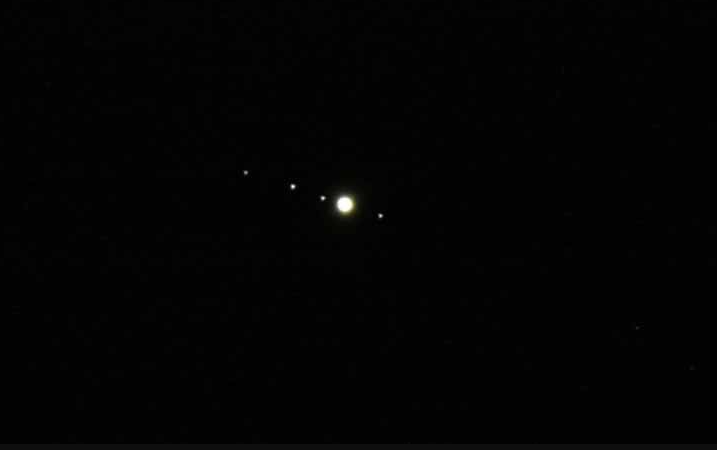
One of the most exciting beginner observations is seeing Jupiter’s four largest moons:
- Io
- Europa
- Ganymede
- Callisto
These appear as tiny dots lined up beside Jupiter.
Their positions change nightly.
Orion Nebula
The Orion Nebula is one of the easiest deep sky objects for beginners.
Even binoculars reveal a faint glowing cloud within Orion’s sword.
You are literally seeing a stellar nursery where new stars form.
The Pleiades
The Pleiades star cluster is breathtaking through binoculars.
Instead of six or seven visible stars, you may suddenly see dozens.
This object is often called the Seven Sisters.
Andromeda Galaxy
The Andromeda Galaxy is the most distant object most people can see with their eyes.
Binoculars reveal it as a larger glowing oval.
You’re observing light that travelled over 2 million years to reach you.
Objects like Andromeda become even more fascinating once you read this beginner’s guide to galaxies and discover what these enormous star systems really are.
Double Stars And Star Clusters
Binoculars are excellent for:
- Open star clusters
- Double stars
- Sweeping the Milky Way
- Bright nebulae
Wide-field views often feel more immersive than telescopes.
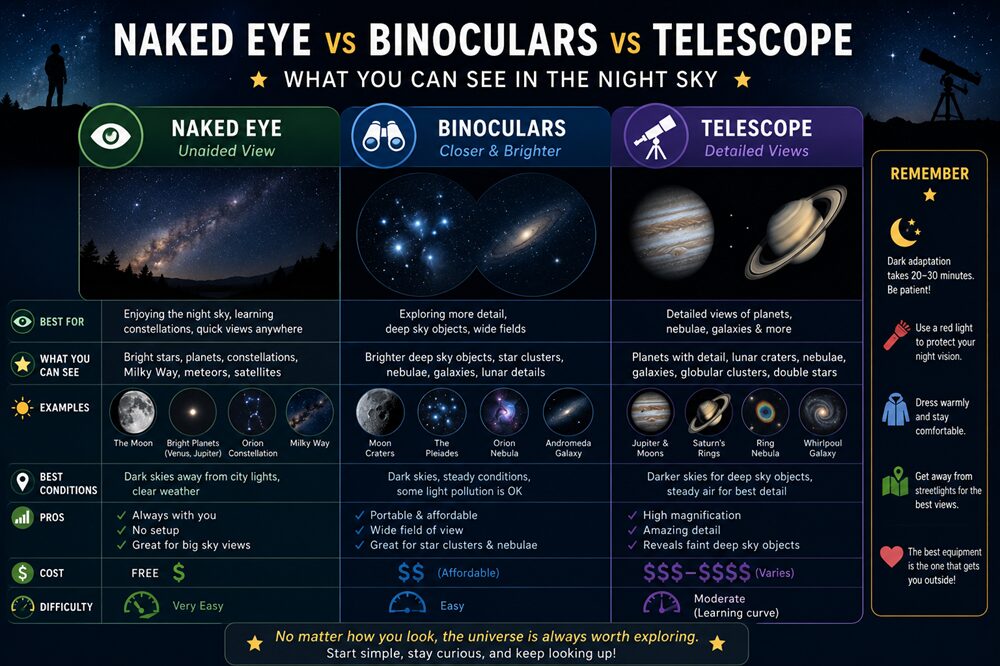
Equipment vs What You Can See
| Equipment | What You Can See |
|---|---|
| Naked Eyes | Moon phases, planets, constellations, meteors |
| Binoculars | Moon craters, Jupiter’s moons, star clusters |
| Small Telescope | Saturn’s rings, nebulae, planets |
| Large Telescope | Fainter galaxies, globular clusters, planetary detail |
What Can You See With A Telescope?
A telescope opens up an entirely new level of astronomy.
However, beginners should have realistic expectations.
Visual astronomy does not usually look like colourful NASA photographs.
Most galaxies and nebulae appear faint grey or slightly greenish because human night vision struggles with colour in low light.
That said, seeing these objects with your own eyes is incredibly rewarding.
Ready to upgrade from naked-eye observing? This beginner telescope buying guide will help you in choosing the right telescope for your needs.
Saturn’s Rings
Saturn is the object that makes many people fall in love with astronomy.
Even a small telescope reveals its famous ring system.
The first time you see Saturn for yourself is unforgettable. (Certainly was for me!)
Jupiter’s Cloud Bands
A telescope reveals:
- Jupiter’s cloud bands
- Moons in greater detail
- Occasional moon shadows
- The Great Red Spot during favourable conditions
Atmospheric conditions heavily affect planetary detail.
Venus Phases
Like the Moon, Venus goes through phases.
A telescope clearly shows crescent Venus during parts of its orbit.
Mars During Opposition
Mars becomes most impressive during opposition, when Earth passes closest to it.
Under steady skies, telescopes may reveal:
- Polar ice caps
- Dark surface markings
- Orange colouration
Nebulae And Galaxies
Telescopes reveal countless deep sky objects:
- Nebulae
- Galaxies
- Globular clusters
- Planetary nebulae
Dark skies matter enormously here.
A small telescope under dark skies often outperforms a larger telescope under city lights.
Aperture Matters More Than Magnification
One of the biggest beginner misconceptions is believing magnification is everything.
In reality:
- Aperture gathers light
- More light reveals more detail
- Excessive magnification often worsens views
A stable, sharp image is far better than extreme zoom.
What Beginners Expect vs Reality
| Expectation | Reality |
|---|---|
| Bright colourful galaxies | Mostly faint grey fuzzies visually |
| Huge planetary images | Small but detailed discs |
| Instant easy viewing | Requires patience and practice |
| Expensive gear required | Many objects visible with simple equipment |
Best Night Sky Objects For Beginners
1. The Moon
What it is: Earth’s natural satellite
Best viewed with: Eyes, binoculars or telescope
Best season: All year
Difficulty: Very easy
Fun fact: Footprints from Apollo astronauts still remain on the Moon.
2. Jupiter
What it is: The Solar System’s largest planet
Best viewed with: Binoculars or telescope
Best season: Varies yearly
Difficulty: Easy
Fun fact: Jupiter has over 90 known moons.
3. Saturn
What it is: A gas giant famous for its rings
Best viewed with: Telescope
Best season: Late summer and autumn often work well
Difficulty: Easy
Fun fact: Saturn could float in water because its density is lower than water.
4. Orion Nebula
What it is: A star-forming nebula
Best viewed with: Binoculars or telescope
Best season: Winter
Difficulty: Easy
Fun fact: New stars are actively forming inside it.
5. The Pleiades
What it is: An open star cluster
Best viewed with: Binoculars
Best season: Autumn and winter
Difficulty: Very easy
Fun fact: The cluster contains hundreds of stars.
6. Andromeda Galaxy
What it is: Our nearest major galactic neighbour
Best viewed with: Binoculars or telescope
Best season: Autumn
Difficulty: Moderate
Fun fact: It’s moving toward the Milky Way.
7. Polaris
What it is: The North Star
Best viewed with: Naked eye
Best season: All year in the Northern Hemisphere
Difficulty: Easy
Fun fact: Polaris helps navigators find north.
8. The Milky Way
What it is: Our home galaxy
Best viewed with: Naked eye under dark skies
Best season: Summer
Difficulty: Moderate
Fun fact: The Milky Way contains hundreds of billions of stars.
Top 10 Easiest Night Sky Objects Checklist
- Moon
- Venus
- Jupiter
- Saturn
- Orion Nebula
- Pleiades
- Polaris
- Andromeda Galaxy
- Big Dipper
- Milky Way
Seasonal Night Sky Highlights
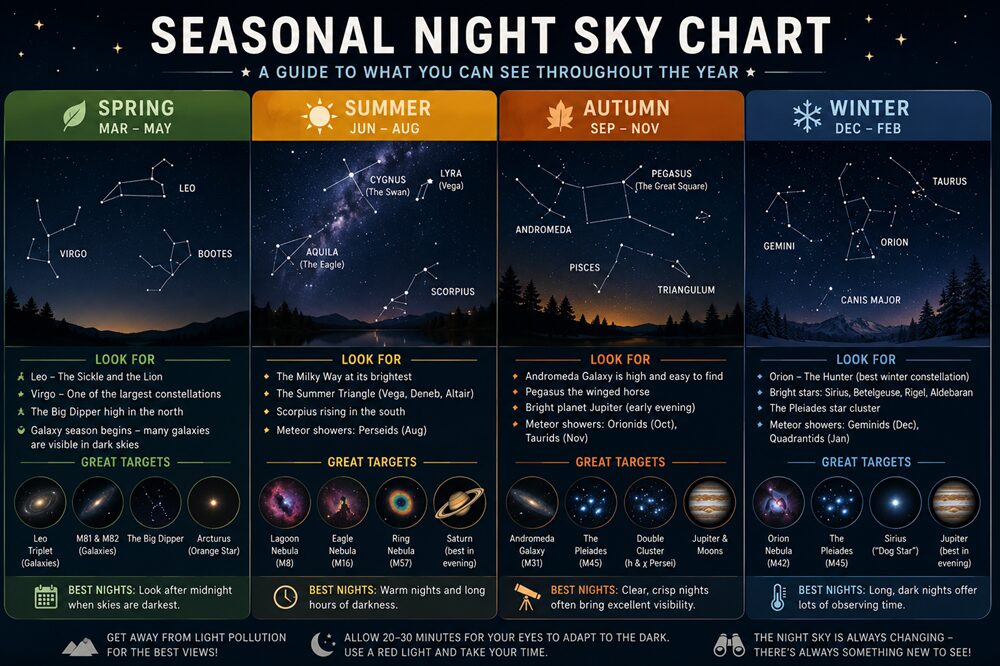
Spring
Spring skies feature:
- Leo
- Virgo
- Coma Berenices
Galaxy hunting becomes especially popular during spring.
Summer
Summer offers:
- The Milky Way
- Scorpius
- Sagittarius
- Summer Triangle
This is often the best season for naked eye astronomy.
Autumn
Autumn skies include:
- Pegasus
- Andromeda
- Pisces
The Andromeda Galaxy dominates autumn observing.
Winter
Winter features some of the brightest constellations:
- Orion
- Taurus
- Gemini
- Canis Major
Many beginners consider winter the best season for stargazing.
How To Find Objects In The Night Sky
Use Stargazing Apps
Modern astronomy apps make locating objects dramatically easier.
Popular beginner apps include:
- SkySafari
- Stellarium
- Sky Guide
Simply point your phone upward to identify stars and planets.
Learn Constellations First
Constellations act as maps for finding deeper objects.
Start with:
- Orion
- Big Dipper
- Cassiopeia
Once these become familiar, navigation becomes much easier.
Use A Red Flashlight
White light ruins dark adaptation.
Red flashlights preserve night vision while allowing you to read charts.
Find Dark Sky Locations
The darker the sky, the more you’ll see.
Even driving 20–30 minutes away from city lights can transform observing conditions.
Let Your Eyes Adapt
Dark adaptation takes time.
Your eyes may need 20–30 minutes before faint objects become visible.
Patience is essential in astronomy.
Light Pollution And Why It Matters
Light pollution is one of the biggest obstacles in amateur astronomy.
Streetlights, buildings and urban glow wash out faint night sky objects.
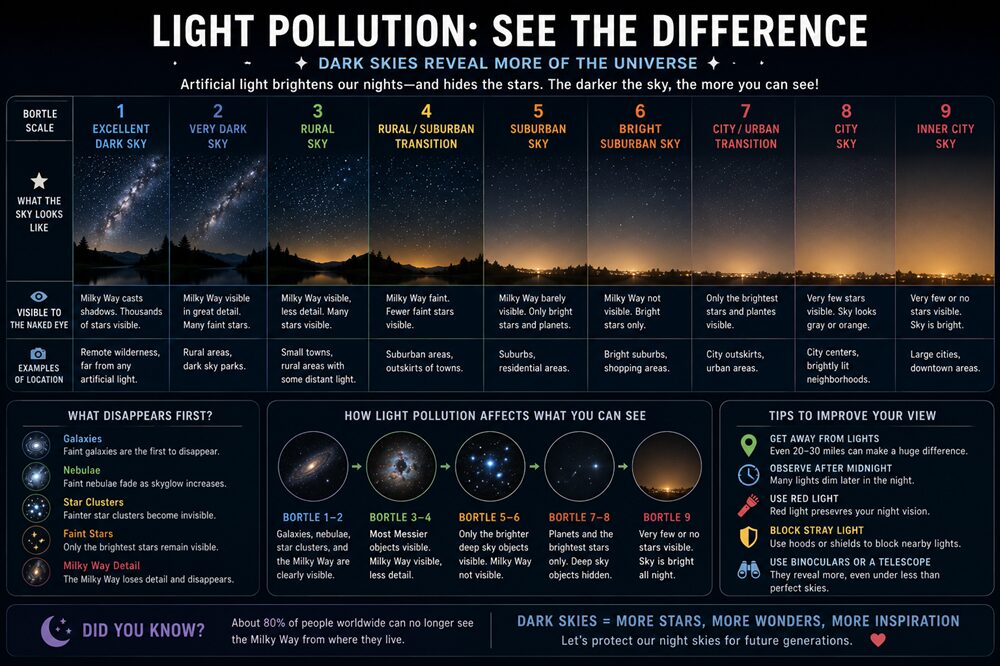
Understanding The Bortle Scale
The Bortle Scale measures sky darkness.
- Bortle 1 = extremely dark skies
- Bortle 9 = inner-city skies
Under dark rural skies, thousands more stars become visible.
What Disappears First?
Faint objects disappear first:
- Galaxies
- Nebulae
- Milky Way detail
Bright planets and the Moon remain visible even in cities.
How Beginners Can Improve Visibility
- Observe after midnight
- Shield stray light
- Use binoculars
- Visit darker locations
- Avoid Full Moon periods for deep sky observing
What You Can See In The Night Sky At A Glance
| Object | Visible With | Best Time | Difficulty |
|---|---|---|---|
| Moon | Eyes/Binoculars/Telescope | All year | Easy |
| Jupiter | Eyes/Binoculars | Evening sky seasons vary | Easy |
| Saturn | Telescope | Late summer/autumn | Easy |
| Orion Nebula | Binoculars/Telescope | Winter | Easy |
| Andromeda Galaxy | Binoculars | Autumn | Moderate |
| Milky Way | Naked eye | Summer | Moderate |
| Venus | Naked eye | Dawn/dusk | Very easy |
| Pleiades | Naked eye/Binoculars | Autumn/winter | Easy |
Every Astronomer Starts Somewhere
Every experienced astronomer started exactly where you are now: looking up and wondering what they were seeing.
You don’t need expensive equipment to enjoy astronomy. A simple pair of binoculars, along with some patience and curiosity, can provide years of discovery.
The most valuable skill in astronomy is simply spending time under the stars.
Frequently Asked Questions
Yes. Under dark skies, the Andromeda Galaxy is visible to the naked eye.
Venus is usually the easiest because it’s extremely bright.
Most nebulae appear greyish visually. Cameras capture more colour than human eyes.
- Moon craters
- Saturn’s rings
- Jupiter’s moons
- Bright nebulae
- Some galaxies
Absolutely. Binoculars are affordable, portable and excellent for beginners.
Next Steps
Once you begin recognising objects in the sky, astronomy becomes even more rewarding.
Your next steps could include:
- Learning seasonal constellations
- Trying binocular astronomy
- Visiting a dark sky location
- Joining a local astronomy club
- Learning astrophotography basics
Most importantly, keep looking up regularly.
The sky rewards familiarity.
Final Thoughts
The night sky is one of the few wonders still freely available to everyone.
Whether you’re spotting Jupiter from your back garden, tracing constellations on a winter evening, or seeing the Milky Way for the first time under dark skies, astronomy has a unique way of reconnecting us with curiosity and perspective.
You don’t need expensive gear or expert knowledge to begin. All you really need is clear skies, patience and the willingness to look up.
And once you start exploring, you may never see the night sky the same way again.
Ready to explore even more beginner-friendly astronomy guides?
Browse more tutorials, telescope guides and stargazing tips on AstronomyShack.com and continue your journey through the night sky.