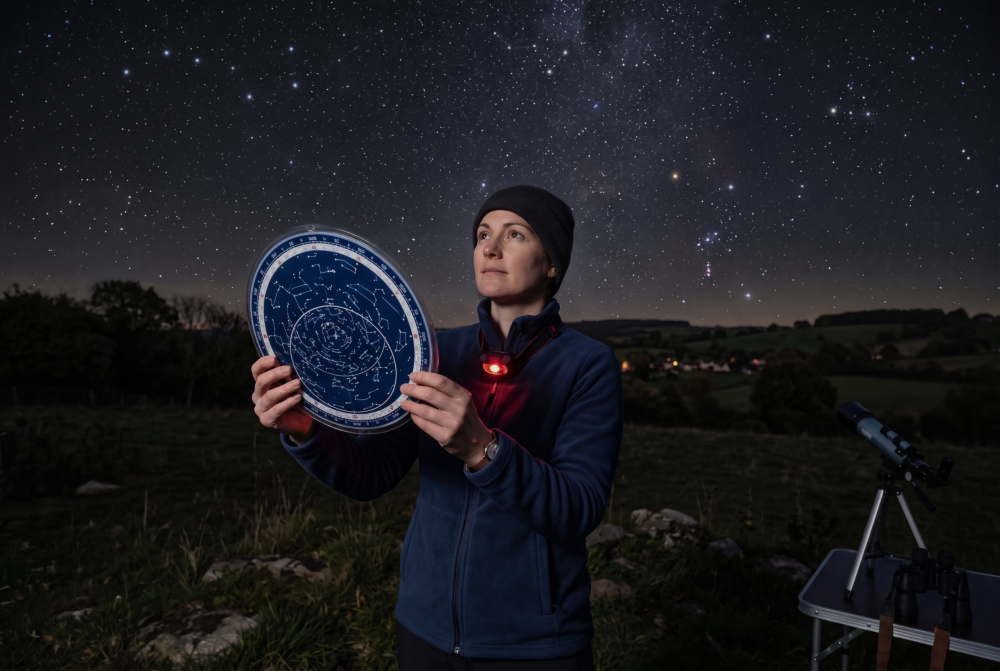
If you are just starting to explore the night sky, a planisphere can be one of the simplest and most useful astronomy accessories you can own.
Unlike a smartphone app, a traditional planisphere needs no batteries, internet connection or software updates. You simply set the date and time, hold it in the correct orientation and compare the stars shown on the chart with the sky above you.
That simplicity is part of its appeal. A good planisphere does more than tell you what is visible tonight: it helps you learn how the constellations fit together and how the night sky changes throughout the year.
Astronomy apps are excellent too, particularly when you want to identify a specific object or see the sky in real time. But for learning the basic patterns of the stars, there is still something satisfying about using a physical star finder.
Note: This post contains affiliate links. If you buy through these links, I may earn a small commission at no extra cost to you. As an Amazon Associate, I earn from qualifying purchases.
TL;DR: Best Planispheres at a Glance
| Planisphere | Best for | Approx. price | Key feature |
|---|---|---|---|
| Philip’s Planisphere (Latitude 51.5 North) | Best Overall | £10–£15 | Excellent all-round UK star chart |
| The Night Sky Planisphere 50°–60°N | Best Large Format | £15–£25 | Large, easy-to-read design |
| DK Planisphere and Starfinder | Best for Beginners | £17–£20 | Guide and planisphere in one |
Before You Buy a Planisphere
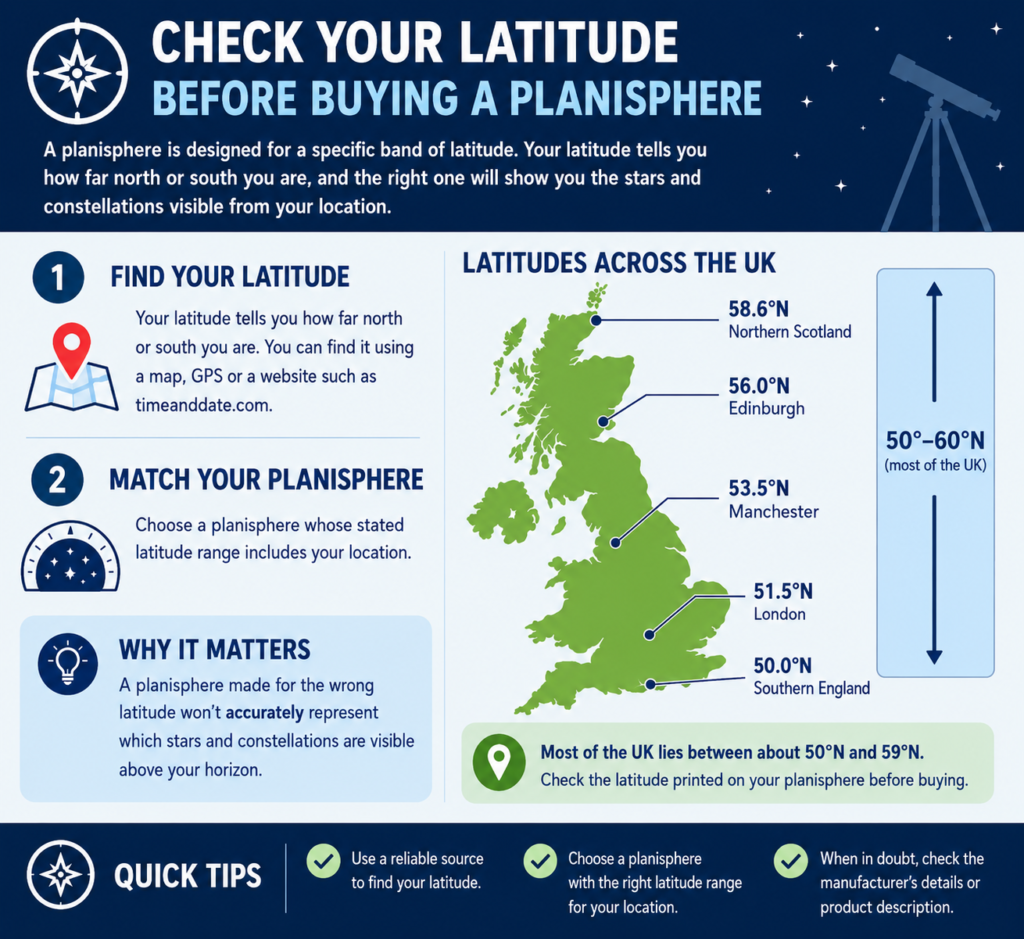
A planisphere looks simple, but there is one important detail you need to get right: latitude. Here are the main things to consider before buying one.
1. Check Your Latitude
A planisphere is designed for a particular latitude because the part of the sky visible from one location is not exactly the same as the sky visible from another.
For example, Philip’s 51.5° North planisphere is specifically intended for Britain and Ireland, as well as northern Europe and parts of North America. The manufacturer describes it as suitable for observers around 51.5°N, with a useful range of approximately 10 degrees either side.
That makes it a very practical choice for most observers in England, Wales and Ireland.
If you live considerably farther north or south, check the latitude printed on the planisphere before buying.
2. Check the Date and Time Range
A planisphere works by rotating one part of the chart against another.
Align the current date with the current time, and the viewing window shows the part of the sky that should be above the horizon.
This is why you do not need a separate chart for every night of the year.
3. Think About Size
A compact planisphere is easy to keep in a coat pocket or observing bag.
A larger model, however, can be easier to read in the dark because the stars and constellation names have more room.
For children, portability can be particularly useful. For adults who intend to spend longer periods outside, a larger chart may be easier on the eyes.
4. Look for Ease of Use
The best planisphere for a beginner is not necessarily the one showing the greatest number of stars.
Too much information can make the chart intimidating.
Look for clearly marked constellations, easily identifiable bright stars and instructions that explain how the rotating parts work.
5. Consider Durability
A planisphere may spend quite a lot of time outdoors.
Plastic or laminated construction can therefore be preferable to an ordinary paper star chart, particularly if you intend to use it on damp evenings.
6. How Much Detail Do You Need?
A simple planisphere is primarily a learning tool.
It is designed to help you answer: “What stars and constellations can I see tonight?”
A detailed star atlas has a different purpose. It may contain thousands of stars and many faint deep-sky objects.
For a beginner, starting with a simple planisphere is often less confusing.
7. Northern or Southern Hemisphere?
Planispheres are not universal.
An observer in Australia, for example, needs a southern-sky version rather than a planisphere designed for Britain.
Always check the latitude and hemisphere before buying.
What Is a Planisphere?
A planisphere is essentially a rotating star chart.
It normally consists of:
- a map showing stars and constellations
- a rotating disc showing dates and times
- a viewing window showing the portion of the sky that should be visible
When you rotate the disc until the date and time are correctly aligned, the window reveals the stars that should be above your horizon.
It does not show the entire sky at once. Instead, it gives you a snapshot of the sky for a particular date and time.
That makes a planisphere particularly useful for learning the night sky because you can take it outside, identify a familiar constellation and then use that constellation to find your way towards other stars.
If you’re completely new to astronomy and would like to understand the subject before exploring the night sky, our What Is Astronomy? guide is a great place to start.
How to Use a Planisphere
Using a planisphere is much easier than it might first appear.
1. Find today’s date
Locate the current date around the edge of the planisphere.
2. Find the current time
Locate the corresponding time marking.
3. Rotate the chart
Turn the rotating disc until the date and time line up.
4. Face the correct direction
Hold the planisphere so that the direction you are facing corresponds with the correct direction on the chart.
5. Compare chart and sky
Look at the stars above you and compare their patterns with those shown on the planisphere.
6. Start with the obvious
Do not try to identify twenty constellations at once.
Begin with an easy pattern such as Orion, the Plough or Cassiopeia and work outward from there.
A practical example: finding Orion
Suppose you are outside on a winter evening and want to find Orion.
Set the planisphere to the current date and time and orient it correctly.
Look for Orion’s distinctive three-star belt on the chart. Once you have located it, look for the same three-star pattern in the real sky.
Once Orion is recognised, several other stars and constellations become easier to find.
That is one of the great strengths of a planisphere: it teaches you to recognise relationships between stars rather than simply pointing at an object on a screen.
Once you’ve learned how to use a planisphere, you may be wondering what you can actually find above you. Our What Can You See in the Night Sky? guide explores some of the highlights to look for.
Our 3 Best Planispheres for Stargazing
(We’ve deliberately limited our recommendations to three planispheres rather than filling the list with similar or poorly reviewed alternatives. Each one offers something genuinely useful for a different type of stargazer.)
1. Philip’s Planisphere (Latitude 51.5 North)
Philip’s Planisphere is probably the safest all-round recommendation for a British beginner.
The current edition is designed around 51.5° North and is intended for Britain and Ireland, northern Europe, northern USA and Canada. It shows stars and constellations down to approximately magnitude 5 and includes a planet tracker and seasonal observing guidance.

Why it’s great
The main attraction is simplicity. Turn the disc to the date and time and the planisphere reveals the corresponding night sky.
The chart is detailed enough to be useful without becoming overwhelming, making it a good bridge between simply looking at the stars and learning to navigate the sky for yourself.
It is also a particularly sensible choice for UK readers because its latitude is designed specifically with British and Irish observers in mind.
Pros
- Designed specifically for UK and Irish observers
- Beginner-friendly
- Shows stars down to magnitude 5
- Includes a planet tracker
- Established astronomy product
Cons
- Not suitable for every latitude
- A traditional planisphere has less detail than a full star atlas
Best for: Anyone in the UK looking for a straightforward, dependable first planisphere.
2. The Night Sky Planisphere 50°–60°N (Large Plastic)
The Night Sky takes a slightly different approach from the traditional rotating disc design.
Its two-sided layout is intended to reduce the distortion that occurs when the entire sky is represented on one conventional flat planisphere. The manufacturer also emphasises its large format, simple constellation patterns and readability.
The 50°–60°N version is particularly relevant to observers in northern parts of the UK.


Why it’s great
The large format is the main attraction.
Rather than squeezing everything into a small circular chart, The Night Sky uses two sides to give the map more space. Bright stars and constellation patterns are emphasised, which can make it easier for beginners to match the chart to the real sky.
It also includes a selection of deep-sky objects suitable for binocular observing.
This is a particularly interesting choice for somebody who has already started learning the constellations and wants something a little more substantial.
Pros
- Large and easy to read
- Designed to reduce map distortion
- Simple constellation patterns
- Includes some deep-sky objects
- Useful for binocular observers
Cons
- More expensive than basic planispheres
- 50°–60°N is not the correct latitude range for every UK observer
- Less compact than a pocket-sized star finder
Best for: Observers who prefer a large, easy-to-read chart
3. DK Planisphere and Starfinder
If you are buying a planisphere for somebody who is completely new to astronomy, this DK option deserves serious consideration.
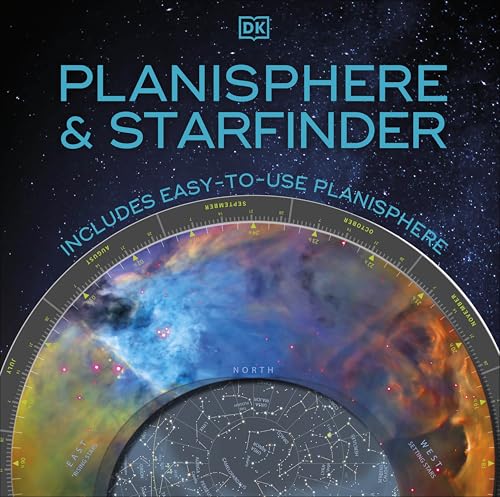
Published in 2024, Planisphere and Starfinder combines a 128-page astronomy guide with a removable planisphere. DK describes it as a beginner’s guide to exploring the night sky, covering the Moon, planets, comets, asteroids, constellations and seasonal observing.
Why it’s great
The big advantage here is that the reader does not have to work out everything from a planisphere alone.
The book explains basic stargazing techniques and introduces the constellations, while the removable planisphere gives the reader a practical tool to take outside.
That makes it particularly attractive as an astronomy gift.
Rather than simply handing somebody a star chart, you are giving them something that explains what they are looking at and how to begin exploring the sky.
Pros
- Includes a removable planisphere
- 128-page beginner’s guide
- Covers constellations and Solar System objects
- Excellent astronomy gift
- Suitable for people starting from scratch
Cons
- Larger and heavier than a simple planisphere
- More expensive than a basic star finder
Best for: Complete beginners who want a learning guide as well as a star finder
Planisphere Comparison Table
| Planisphere | Best for | Size/type | Waterproof? | Skill level | Key advantage |
|---|---|---|---|---|---|
| Philip’s 51.5°N | UK beginners | Traditional rotating chart | *Not confirmed | Beginner | Excellent UK coverage |
| The Night Sky 50°–60°N | Larger-format observing | Large two-sided plastic | Plastic construction | Beginner/intermediate | Clear, less-distorted layout |
| DK Planisphere and Starfinder | New astronomers | Book + removable planisphere | No | Beginner | Learning guide included |
The Philip’s 51.5°N hardcover planisphere isn’t explicitly described as waterproof, so treat it as a standard hardcover paper product and protect it from water exposure.
Which Planisphere Is Best for You?
Choose Philip’s Planisphere if you are in Britain or Ireland and want the best straightforward all-round option.
Choose The Night Sky if you prefer a larger chart and live within the appropriate 50°–60°N latitude range.
Choose DK’s Planisphere and Starfinder if you are buying for somebody who is completely new to astronomy or want a particularly useful astronomy gift.
For most UK beginners, however, I would start with Philip’s 51.5°N planisphere.
Planisphere vs Astronomy App
A planisphere and an astronomy app do broadly the same basic job, but they approach it very differently.
| Feature | Planisphere | Astronomy app |
|---|---|---|
| Works without battery | Yes | No |
| Easy to carry | Yes | Yes |
| Shows real-time sky position | No | Yes |
| Helps learn constellations | Excellent | Good |
| Works without internet | Yes | Often, depending on app |
| Light pollution impact | None from the chart itself | Phone screen can affect dark adaptation |
| Beginner friendliness | Excellent once learned | Very easy initially |
| Cost | Usually inexpensive | Often free or inexpensive |
There is no need to choose one or the other.
An app is particularly useful when you want to identify an unfamiliar object or point your phone towards a particular part of the sky.
A planisphere is excellent for learning the overall pattern of the constellations.
There is also the issue of dark adaptation. Looking at a bright phone screen while observing can interfere with your eyes’ ability to adjust to darkness, although many astronomy apps provide red-light or night modes.
For many beginners, the best approach is simply to use both.
Can You Use a Planisphere With Binoculars?
Absolutely. A planisphere is particularly useful before you look through binoculars.
It can help you understand which constellations are visible and where the brighter stars are located. This helps you decide what you can reasonably expect to find during an observing session.
However, a planisphere is not as detailed as a star atlas. It generally will not show enough faint stars to help you navigate precisely to a difficult deep-sky object.
Think of a Planisphere and Star atlas as serving different purposes:
- Planisphere: Learn the overall night sky – It helps you recognise the constellations and understand how the sky changes with the seasons. This is particularly useful for binoculars, where you can explore brighter stars and larger objects.
- Star atlas: Navigate towards fainter targets – A detailed star atlas contains far more information and becomes increasingly useful when you begin hunting for faint galaxies, nebulae and star clusters. This makes a star atlas good for telescope use, where you can observe objects in greater detail.
Binoculars can also be a great way to explore the night sky without jumping straight to a telescope. Our guides to binocular astronomy and essential accessories can help you get started.
If you are still choosing your first telescope, our guide to How to Buy a Telescope – A Beginner’s Guide is a natural next step.
Planispheres as Astronomy Gifts
A planisphere makes a surprisingly good astronomy gift because it encourages the recipient to go outside and actually use it.
It can work particularly well for:
- beginner astronomers
- children learning about space
- families who enjoy stargazing together
- campers and outdoor enthusiasts
- telescope owners
- people learning the constellations
- astronomy enthusiasts who appreciate traditional observing tools
It is also inexpensive enough to make a useful addition to a larger astronomy gift.
For a younger recipient, a planisphere can turn a general interest in space into something practical: instead of simply reading about Orion, the child can go outside and try to find it.
For an adult who already owns a telescope, it can be a useful companion for planning an observing session.
If you’re looking for more astronomy-themed gift ideas, our Best Gifts for Astronomy Lovers guide brings together plenty of suggestions, from practical equipment to fun space-themed presents.
For even more astronomy-related gift ideas, books and activities, explore our Gifts & Books hub, where you’ll find our growing collection of recommendations and guides.
Common Mistakes Beginners Make
Buying the wrong latitude
This is probably the biggest mistake to avoid. Always check the latitude printed on the planisphere before buying.
Holding it upside down
The chart needs to be oriented correctly. If you are facing north, for example, the north edge of the planisphere should correspond with the northern horizon.
Forgetting to orient the chart
Aligning the date and time is only half the job. You also need to hold the planisphere in the correct direction.
Expecting it to show planets precisely
The planets move against the background stars, so their positions change. Some planispheres include planet information or trackers, but they are not a replacement for current planetary data.
Expecting it to show every faint object
A planisphere is not a detailed deep-sky atlas.
Looking only at the chart
The purpose of the planisphere is to help you connect the chart with the real sky. Look up regularly.
Trying to learn everything at once
Pick one or two constellations and learn them properly.
Once you recognise them, use them as stepping stones to the surrounding sky.
Best Planispheres for Stargazing – FAQ’s
A planisphere is used to identify which stars and constellations should be visible at a particular time and date. It is particularly useful for learning the night sky.
A good planisphere can be very accurate for its intended latitude and date/time range. The key is choosing the correct latitude for your observing location.
A 51.5° North planisphere is a particularly useful general choice for Britain and Ireland. Observers in more northerly or southerly parts of the country should check the latitude range of the specific planisphere they are considering. Philip's states that its 51.5°N model is suitable for Britain and Ireland and approximately 10 degrees either side of 51.5°N.
For most UK beginners, Philip's Planisphere at 51.5° North is an excellent starting point because it is simple to use and specifically designed for Britain and Ireland.
Not necessarily. Planispheres are designed for particular latitudes and hemispheres, so you need to select an appropriate version for your location.
Some include planet information or trackers, but planets move across the sky and their positions change. A planisphere should not be treated as a complete real-time planetary guide.
They have different purposes. A planisphere is especially useful for showing what is visible at a particular time and date, while a fixed star map or atlas can provide considerably more detail.
Yes. In fact, a simple planisphere can be an excellent educational astronomy tool for children because it encourages them to match the patterns on the chart with the real sky.
You do not need one, but it can still be useful. A planisphere helps you learn the constellations and understand the overall sky before moving on to detailed telescope charts.
Yes. They complement each other very well. An app can help identify individual objects, while a planisphere can help you learn the larger patterns of the night sky.
Final Thoughts
A planisphere may look like a very simple piece of astronomy equipment, but that is precisely why it remains useful.
You do not need to charge it, update it or learn how to operate complicated software. Set the date and time, point it in the right direction and start matching the patterns on the chart with the stars above you.
For most UK beginners, Philip’s Planisphere (Latitude 51.5 North) is the strongest all-round choice. If you want something specifically suited to outdoor use, the Night Sky Planisphere 50°–60°N (Large Plastic) is worth considering, while DK’s Planisphere and Starfinder is particularly appealing as an astronomy gift or beginner’s learning resource.
And perhaps most importantly, remember that the best planisphere is not the one with the most information. It is the one that helps you look up at the real night sky and start recognising what you see.