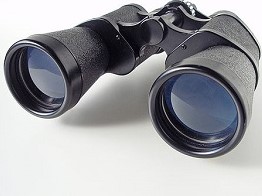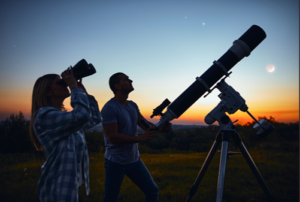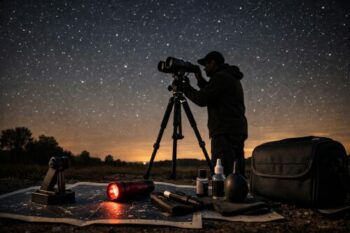
If you’ve ever pointed your binoculars up at the night sky and wished the view could be clearer, steadier, or easier to find objects, this guide is for you.
Binoculars are one of the best entry tools for astronomy, and with just a few accessories, you can dramatically improve your experience.
From stabilising your view to making night-time navigation easier, a few small upgrades can make a huge difference in what you see.
This guide covers every worthwhile accessory, how it helps, who needs it, and when it makes sense to skip it.
Choosing the right binoculars is just as important as the accessories you use – our guide to the best binoculars for stargazing will help you get started.
Why Accessories Matter for Astronomy Binoculars
Binoculars are often recommended by professional astronomers as one of the best tools for beginners getting started with night sky observation.
You can discover some great skywatching tips with NASA’s beginner’s guide to observing the night sky
Binoculars can reveal a surprising amount of detail in the night sky — lunar craters, the Pleiades, Jupiter’s moons, the Andromeda Galaxy, and even faint Milky Way dust lanes.
But two major limitations often get in the way: shakiness and low contrast/poor visibility.
Even high-quality binoculars suffer from these issues, and this is where accessories become essential. A stable mount, a red flashlight, or a simple cleaning kit can instantly transform your experience.
Think of accessories as “performance multipliers”, making your binoculars operate at their full potential.
For a complete overview of binocular gear and how it all fits together, visit our binoculars and accessories hub.
Contents (Jump to Section)
- Binocular Tripod Adapters
- Tripods for Astronomy Binoculars
- Smartphone Adapters
- Red Flashlights
- Binocular Harness
- Cleaning & Maintenance Kits
- Filters for Astronomy Binoculars
- How to Choose the Right Accessories
- Beginner Buying Order – Best Value Choices
- Final Verdict: What You Should Buy First
- FAQ
1. Binocular Tripod Adapters
On their own, binoculars are inherently shaky — especially at magnifications of 10×, 12×, or higher.
A tripod adapter resolves this issue by allowing you to mount your binoculars on a tripod, thereby providing a stable platform for observation.
Who can skip this: Handheld 7× or 8× binocular users observing for short sessions.
Why They Matter
Holding binoculars steady for more than a few minutes is surprisingly difficult. A tripod adapter locks your binoculars in place, providing you with tack-sharp views and allowing you to observe for extended periods comfortably.
Best For:
- 10×50 and higher magnification binoculars
- Long sessions (20+ minutes)
- Lunar and planetary viewing
- Sharing views with friends or family
Types of Adapters:
Most fall into three categories:
- Metal L-Brackets — strongest and most stable
- Quick-Release Adapters — ideal if switching between devices
- Centre-post adapters — perfect for Porro-prism binoculars
A good adapter is one of the biggest performance upgrades you can buy — often more impactful than upgrading the binoculars themselves.
To eliminate hand shake and enjoy longer sessions, see our guide to the Best Binocular Tripod Adapters for Astronomy
2. Tripods for Astronomy Binoculars
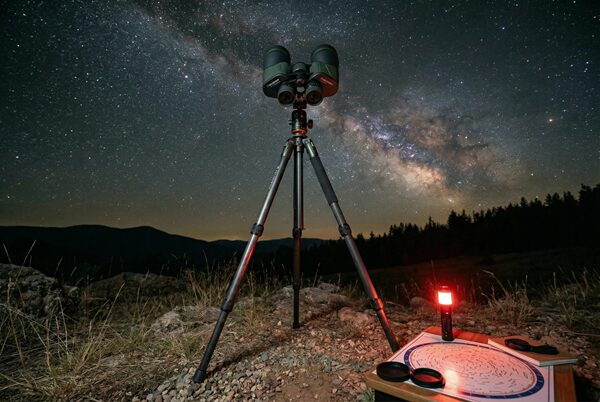
A tripod paired with an adapter is the single most transformative accessory for binocular astronomy. Without a tripod, all the optical performance in the world is wasted because your view will always shake.
What to Look For
When choosing a tripod for stargazing, prioritise:
- Standing eye-level height
- A fluid pan/tilt head for smooth sweeping across the night sky
- 3–5kg payload to ensure stability
- Quick-release plate for easy setup
A proper tripod turns your binoculars into a small, stable telescope — ideal for scanning star fields, observing the Moon, or exploring bright deep-sky objects. If you buy only one accessory, make it this.
3. Smartphone Adapters (Digiscoping)
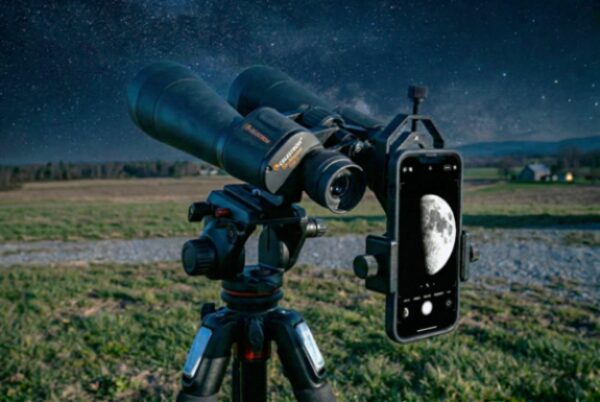
Smartphone adapters let you take photos through your binocular eyepiece — a fun way to capture Moon craters, planetary alignments, or starry wide-field scenes.
Expect a learning curve — alignment takes patience, especially at night.
Benefits:
- Record Moon craters
- Share stargazing moments instantly
- Log observations for astronomy notes
What To Look For:
- Wide adjustable phone clamp
- Secure eyecup grip
- Easy rotation and alignment
If you want to try capturing images through your binoculars, our guide to the best smartphone adapters for binoculars covers the top options.
Your first Moon photo will always feel magical — even if it isn’t perfect. These adapters are inexpensive and great for beginners who want to try astrophotography.
4) Red Flashlights (A Must-Have)
A red flashlight is one of the most essential accessories for astronomy. Unlike white light, red light preserves night vision, allowing your eyes to stay adapted to the dark so faint stars remain visible.
Why You Need One
A single blast from a white torch can wipe out your night vision for 20–30 minutes. A red flashlight lets you:
- Read star charts
- Adjust binocular settings
- Walk safely at night
- Record notes without losing your dark adaptation
A red flashlight is one of the simplest but most effective upgrades – see our guide to the best astronomy flashlights for stargazing.
Once you start using one, you’ll never go back.
5) Binocular Harnesses & Carry Systems
If you walk around observing, attend star parties, or travel between viewing spots, a normal neck strap quickly becomes uncomfortable. A binocular harness spreads the weight across your shoulders for long-term comfort.
Benefits
- Zero neck strain
- Hands-free walking
- Binoculars stay secure and ready
Discover some of the best binocular harnesses for astronomy. These are especially helpful with heavier 50mm or 56mm binoculars.
6) Cleaning & Maintenance Kits
Even the best optics lose performance if the lenses are dusty, oily, or fogged up. A simple cleaning kit ensures you always get the brightest, sharpest views.
What You Need
- Microfibre cloth
- Lens-cleaning solution
- Soft brush or air blower
- Lens pen for fine cleaning
Golden Rule
Never clean lenses when they are dry — dust can act like sandpaper and scratch the coatings.
Keeping your lenses clean is essential for sharp views – see our guide to the best binocular cleaning kits.
7) Filters for Astronomy Binoculars
Filters are optional but can significantly improve contrast, especially in light-polluted areas.
Types That Work Best
- Light Pollution Reduction (LPR) filters — boosts nebula and galaxy contrast
- Moon filters — reduce glare for more comfortable viewing
What You’ll Notice
- Reduced sky glow
- Better detail in bright objects
- Enhanced contrast for clusters and nebulae
Not essential for beginners, but a nice upgrade for specific observing targets.
(How to Choose the Right Accessories – Quick Guide)
With so many accessories available, it’s easy to overspend on gear you don’t actually need.
Instead of buying everything at once, it’s far more effective to match accessories to the specific problem you’re trying to solve — whether that’s shaky views, discomfort, or photographing what you see.
The quick-reference table below shows which accessories deliver the biggest benefit depending on your goal.
| If You Want… | Get This |
|---|---|
| The biggest performance upgrade | Tripod adapter + tripod |
| Comfort during long nights | Harness + red headlamp |
| Better photos | Smartphone adapter |
| Sharper views | Cleaning kit |
| Night-sky navigation | Red flashlight + star charts |
| Fog-free optics | Anti-fog wipes |
(Beginner Buying Order – Best Value Choices)
If you’re new to binocular stargazing, some accessories deliver a much bigger improvement than others. The order you buy them matters.
The table below shows the best sequence to add accessories based on overall value, impact on viewing quality, and usefulness for most beginners.
| Accessory | Value for Stargazing | Recommended When |
|---|---|---|
| Tripod Adapter | ⭐⭐⭐⭐⭐ | 10× magnification or higher |
| Tripod | ⭐⭐⭐⭐⭐ | Observing for 20+ minutes |
| Red Light | ⭐⭐⭐⭐ | Every astronomer needs this |
| Cleaning Kit | ⭐⭐⭐⭐ | Especially near coast or dew |
| Smartphone Adapter | ⭐⭐⭐ | For photos & sharing |
| Harness | ⭐⭐⭐ | Hiking or long sessions |
| Filters | ⭐⭐ | Optional upgrade |
Final Thoughts
A few well-chosen accessories can turn any pair of binoculars into a powerful stargazing tool. Whether you want steadier views, more comfort, or the ability to take photos, these upgrades make a huge difference.
Start with stabilisation, add comfort items second, then experiment with photography or filters as your interest grows.
With the proper accessories, a simple pair of binoculars can reveal the wonders of the universe
Frequently Asked Questions
Are tripod adapters worth it for binocular astronomy?
Absolutely — they dramatically improve stability and let you see finer details
What size tripod do I need?
Standing eye level is ideal. Anything shorter will force awkward positions.
Do I need filters for binoculars?
Most beginners don’t, but LPR or Moon filters can improve contrast in certain conditions
Why use red flashlights instead of white?
Red light preserves your night vision so faint stars remain visible
Can I use binoculars for astronomy without a tripod?
Yes, but handheld viewing is best limited to short sessions and lower magnifications. A tripod greatly improves comfort and detail.