How far away are the stars you see in the night sky?
It’s a simple question — but the answer is anything but simple. Space is so vast that using everyday units like miles or kilometres quickly becomes impractical. The distances are just too big to make sense of.
That’s where the term light year comes in.
You’ve probably heard it before, but it’s often misunderstood. Is it time? Distance? Something else entirely?
In this guide, you’ll learn exactly what a light year is, how far it really is, and why astronomers use it. By the end, you’ll have a clear, intuitive understanding — and a new appreciation for just how enormous the universe truly is.
TL;DR – Quick Answer
- A light year is a measure of distance, not time
- It is the distance light travels in one year
- That distance is about:
- 9.46 trillion kilometres
- 5.88 trillion miles
If you’re completely new to astronomy, this beginner’s guide to stargazing will help you take your first steps under the night sky.
What Is a Light Year? (Simple Definition)
A light year is the distance that light travels in one year through space.
Even though the name sounds like it’s about time, it’s actually a way of measuring how far away something is.
Think of it like this: instead of saying “miles travelled,” we’re saying “distance light travels.”
How Far Is a Light Year?
A light year is an incredibly large distance:
- 9.46 trillion kilometres
- 5.88 trillion miles
That’s such a huge number that it’s hard to picture – so we can break it down with comparisons.
Earth to the Sun
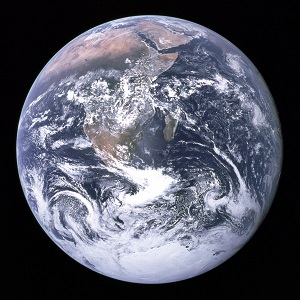
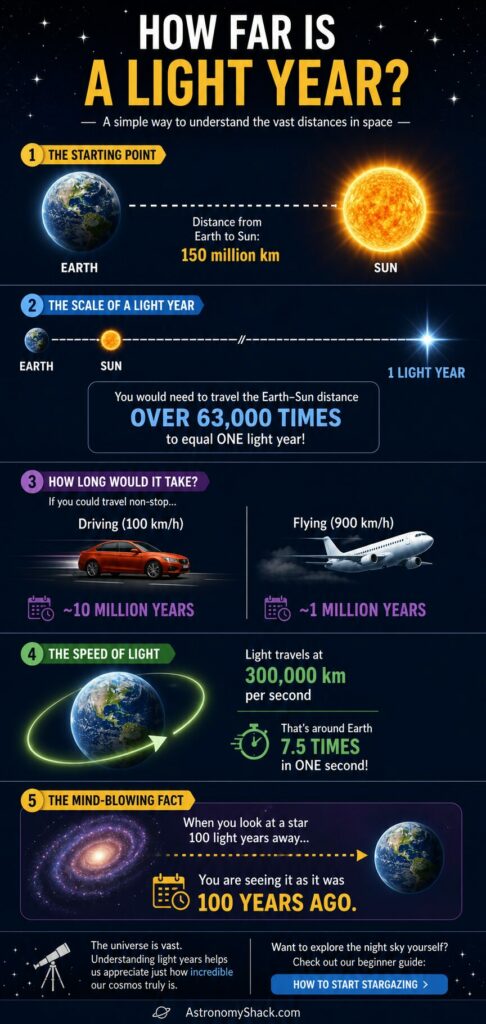
The distance from Earth to the Sun is approximately 150 million kilometres (93 million miles).
That means:
- 1 light year = over 63,000 Earth–Sun distances
Driving a Car

If you could drive a car at 100 km/h non-stop:
- It would take you about 10 million years to travel one light year
Yes — millions of years just to reach the distance light covers in one year!
Flying in a Plane

A commercial plane flies at around 900 km/h.
Even then:
- It would take over 1 million years to travel a single light year!
(When I was younger, and learning about astronomy, I loved this kind of stuff!)
A Simple Analogy
Imagine stacking journeys from Earth to the Sun end-to-end — tens of thousands of times. That’s the scale we’re dealing with.
This is why astronomers needed a better way to describe distance.
Still hard to picture? This simple visual makes it much clearer:
Why Do Astronomers Use Light Years?
Using kilometres or miles in space would quickly get out of hand.
For example:
- The nearest star would be written as 40,000,000,000,000 km away. That’s not very practical.
That’s not very practical. Instead, astronomers say:
- “It’s about 4 light-years away” Much simpler — and easier to understand.
Real Examples
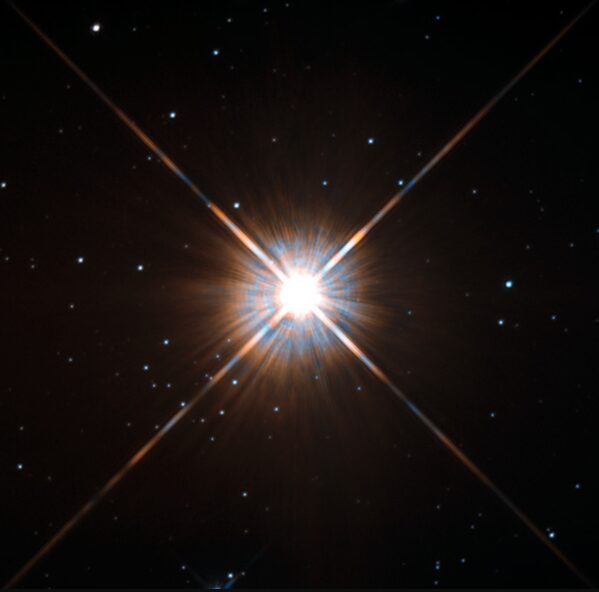
- Nearest star (Proxima Centauri): about 4.24 light-years away
- Centre of our galaxy: about 26,000 light-years away
- Milky Way galaxy width: about 100,000 light-years across
These numbers are still big — but far more manageable than trillions of kilometres. Light-years help us compress enormous distances into something meaningful.
How Fast Is Light?
Light travels incredibly fast:
- About 300,000 kilometres per second
- That’s 186,000 miles per second
To put that into perspective:
Around the Earth
Light could travel around the Earth about 7.5 times in one second
Earth to the Moon
Light takes only:
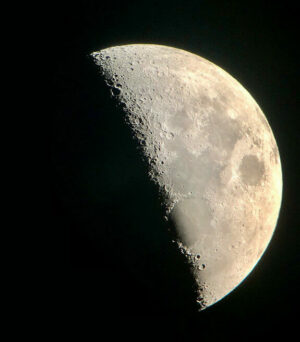
- 1.3 seconds to travel from the Moon to Earth
Earth to the Sun

Light from the Sun reaches us in about:
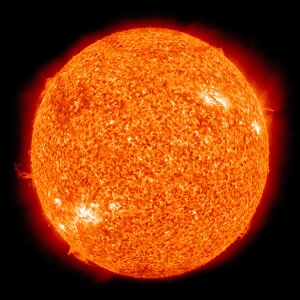
- 8 minutes
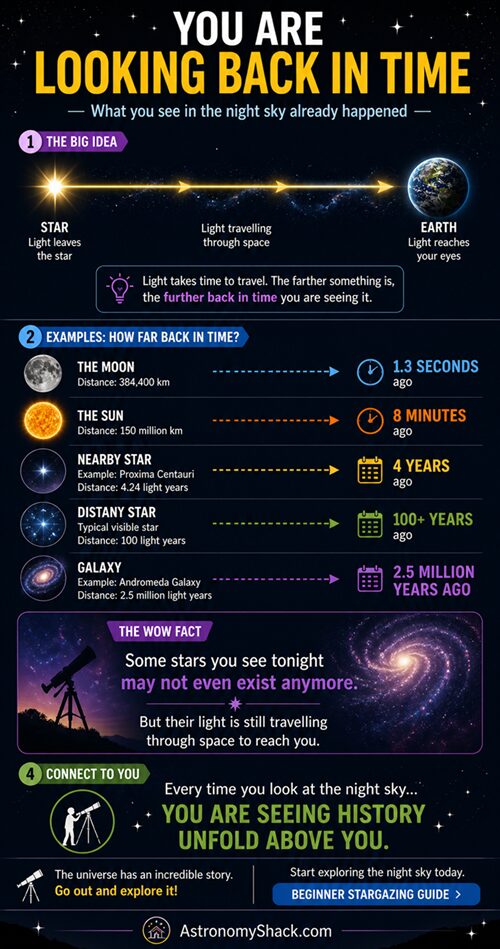
So when you look at the Sun, you’re seeing it as it was 8 minutes ago.
This idea becomes even more fascinating when we look at stars…
Light Year vs Time (Common Confusion)
This is where many people get tripped up.
A light year is not a unit of time.
Even though it contains the word “year,” it does not measure how long something takes — it measures how far something travels.
Why the Confusion?
Because we’re used to words like:
- Hour
- Day
- Year
All of these measure time.
But in this case, “year” is just part of describing how far light travels during that time.
Simple Way to Remember
- Light year = distance
- Year = time
Light Years in Real Astronomy
Now let’s connect this to real objects you can observe.
The Sun
- Distance: 8 light minutes
- Meaning: sunlight takes 8 minutes to reach Earth
The Moon
- Distance: 1.3 light seconds
- Practically instantaneous on human timescales
Nearest Stars
- Proxima Centauri: 4.24 light-years
- When you see it, you’re seeing light that left the star over 4 years ago
Distant Stars
Many visible stars are:
- Hundreds to thousands of light years away
Galaxies
- Andromeda Galaxy: about 2.5 million light years away
This leads to one of the most mind-blowing facts in astronomy…
Mind-Blowing Fact
When you look at distant objects in space, you are literally looking back in time.
- A star 100 light-years away → you see it as it was 100 years ago
- A galaxy 1 million light-years away → you see it as it was 1 million years ago
You’re not just observing space — you’re observing history.
How This Helps You Stargaze
Understanding light-years makes stargazing a much more meaningful experience.
When you step outside and look up:
- You’re not seeing objects as they are now
- You’re seeing them as they were when their light began its journey
That faint star? – It might be hundreds of years in the past
That bright one? – Still years behind what’s happening there right now
Even observing the Moon or planets — which are much closer — becomes more interesting when you understand how light travels.
Final Thoughts
A light year might sound confusing at first, but the idea is actually quite simple.
- It’s a measure of distance, not time
- It represents how far light travels in one year
- And it helps us make sense of the enormous scale of the universe
Without light-years, describing space would be almost impossible. But more importantly, it changes how you see the night sky. Every star you look at is a glimpse into the past — a journey across unimaginable distances, arriving right at your eyes.
And that’s one of the things that makes astronomy so fascinating.
FAQs
A light year is the distance that light travels in one year — about 9.46 trillion kilometres.
No, it’s a unit of distance. The name can be confusing, but it measures how far light travels, not how long it takes.
One light year is approximately 5.88 trillion miles.
Because space distances are so large that kilometres become impractical. Light years make these distances easier to understand.
With current technology, no. Even the fastest spacecraft would take thousands of years to travel one light year.