Everything you need to choose the right telescope, and start observing with confidence.
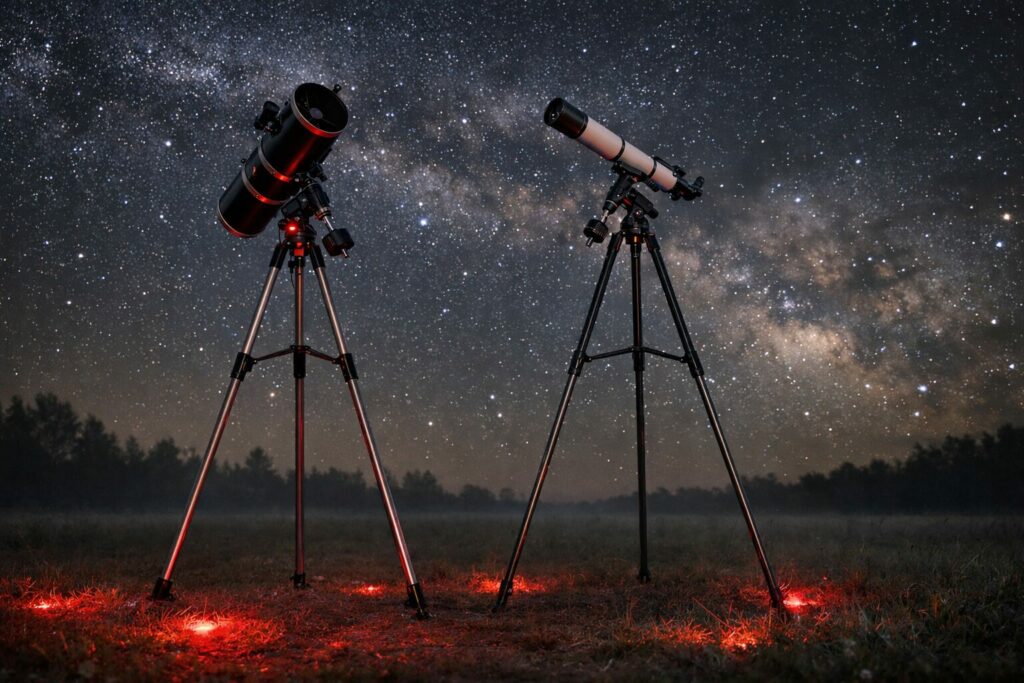
Whether you’re just getting started with stargazing or looking to upgrade your first telescope, choosing the right equipment can feel overwhelming. With so many different telescope types, sizes, and features available, it’s not always obvious which one is best for your needs.
This Telescopes Hub brings together our most helpful beginner-friendly buying guides, telescope comparisons, and setup advice to help you make a confident choice.
From compact tabletop telescopes to easy-to-use refractors and reflectors, you’ll find straightforward buying advice for every level of experience.
Not sure where to begin? Here’s a quick guide to help you choose your starting point.
TL;DR: Where Should You Start?
New to astronomy? Start with our How To Buy A Telescope – A Beginner’s Guide to understand the key differences between telescope types and what to look for before making your first purchase.
Short on space? A tabletop telescope is a compact and affordable way to begin observing the Moon and planets. Explore our guide to the best tabletop telescopes for adults
Want the simplest setup? A refractor telescope offers crisp views with minimal maintenance. Take a look our guide to The Best Refractor Telescopes For Beginners
Looking for maximum value? Reflector telescopes typically provide larger apertures at a lower cost — ideal for deep-sky observing. Check out our guide The Best Reflector Telescopes For Beginners
Buying for a child? Explore our guide to the best telescopes for kids.
Explore All ‘Telescope’ Guides (Index)
Browse all our telescope guides below, organised to help you choose the right scope for your needs.
Telescope Learning Guides
- How to Buy a Telescope – A beginner-friendly guide to aperture, mounts, and telescope types.
Telescope Buying Guides
- Best Reflector Telescopes for Beginners – Excellent value and ideal for deep-sky viewing.
- Best Refractor Telescopes for Beginners – Crisp, high-contrast views with minimal setup.
- Best Tabletop Telescopes for Adults – Compact and easy-to-use beginner scopes.
- Best Telescopes For Kids – A great start for enquiring minds.
Before You Buy: What You Need to Know
If you’re new to astronomy, understanding a few key concepts before choosing a telescope will save you time, money, and frustration.
Not all telescopes are designed for the same purpose, and the right choice depends on what you want to observe and how you plan to use it.
Aperture (the diameter of the main lens or mirror) is the most important factor — it determines how much light the telescope gathers and how much detail you’ll see.
Mount type also matters, as a stable, easy-to-use mount can make a bigger difference to your observing experience than small differences in magnification.
You’ll also need to decide between the main telescope designs:
- Refractor telescopes – low maintenance and simple to use, ideal for beginners.
- Reflector telescopes – offer larger apertures for the price and are excellent for deep-sky objects.
- Tabletop telescopes – compact and portable, perfect if space is limited.
If you’re unsure which direction to take, start with How To Buy A Telescope – A Beginner’s Guide. It walks you through the differences step-by-step so you can choose with confidence.
Once you understand the basics, explore our latest telescope guides and recommendations below.
Latest ‘Telescopes’ Guides
-
The Best Reflector Telescopes For Beginners
Choosing your first telescope can feel overwhelming, especially when you’re faced with unfamiliar terms like aperture, focal length, and equatorial…
-
The Best Refractor Telescopes For Beginners
If you’re taking your very first steps into astronomy, a refractor telescope is one of the safest and most rewarding…
-
Best Tabletop Telescopes For Adults – Beginner’s Guide
If you’re new to astronomy and want something simple, affordable, and easy to use, a tabletop telescope can be…
-
How To Buy A Telescope – A Beginner’s Guide
Buying your first telescope can be exciting, but it’s easy to feel overwhelmed by all the options. Between confusing specs…
-
Best Telescopes For Kids in 2026
Finding the perfect telescope for a child can be the key to unlocking a lifetime of wonder about the cosmos…
Learn to Use Your Telescope
Owning a telescope is only the first step — learning how to use it effectively will make a huge difference to what you see in the night sky. Even a beginner telescope can reveal incredible detail once you understand the basics of setup, magnification, and observing conditions.
Start by learning how different eyepieces affect magnification and how to choose the right one for the Moon, planets, or deep-sky objects. A stable setup, proper focusing, and allowing your telescope to adjust to outdoor temperatures can also dramatically improve image clarity.
It’s also worth learning a few simple observing techniques. Using a red flashlight helps preserve your night vision, while understanding how to find objects using star charts or mobile astronomy apps makes exploring the sky far easier.
If you’re just beginning your stargazing journey, these guides will help you get the most from your telescope and enjoy clearer, more rewarding views of the night sky.
Once you’ve chosen your telescope, the right accessories can dramatically improve your observing experience. Explore our complete Telescope Accessories guide to discover the most useful upgrades for beginners.
Explore More Astronomy Hubs
- Learn Astronomy – Build your understanding of the night sky with beginner-friendly guides, tips, and observing advice.
- Telescope Accessories – Discover must-have accessories to improve comfort, performance, and overall telescope usability.
- Binoculars & Accessories – Explore binoculars for stargazing and the essential accessories to enhance your viewing experience.
- Astrophotography – Learn how to capture stunning images of the night sky with the right gear and techniques.
- Gifts & Books – Find astronomy gift ideas, books and practical accessories for beginners and experienced stargazers.
Choosing the Right Telescope – FAQ’s
For most beginners, a refractor telescope is the simplest place to start. They require very little maintenance, are easy to set up, and provide sharp views of the Moon and planets. However, reflector telescopes often offer larger apertures for the price, making them better for observing faint deep-sky objects.
A good beginner telescope typically falls in the £150–£400 range. Spending too little can result in poor optics and unstable mounts, which often leads to frustration. It’s usually better to invest in a quality entry-level telescope than buy a very cheap model that underperforms.
Not necessarily. Larger telescopes gather more light and can show more detail, but they are also heavier and less portable. A telescope that’s easy to carry and set up will likely be used more often than a larger, more complicated model.
With a quality beginner telescope, you can see detailed views of the Moon’s craters, Jupiter’s cloud bands and moons, Saturn’s rings, and bright deep-sky objects such as the Orion Nebula and some star clusters.
Most beginner telescopes include basic eyepieces, but upgrading to a better eyepiece can noticeably improve image clarity and comfort. A red astronomy flashlight and a stable mount are also helpful additions for more enjoyable observing sessions.